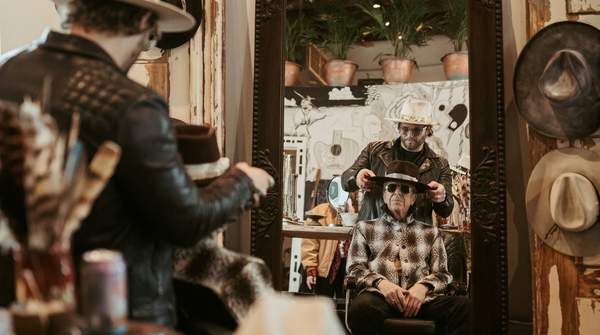
A vintage hat hanging on the wall of an old rodeo hatter’s shop caught Ryan McGrath’s attention. He asked whether the hatmaker could recreate its look and let him watch the process, setting off an interest that would eventually develop into an Austin hatmaking business.
McGrath had already experimented with several artistic mediums, but something about working with hats held his attention. What followed was a year of trial, error, and figuring things out largely through his own experimentation. Those experiences helped shape Trovador, the handcrafted hat studio he established around an approach to art that was distinctly his own.
The Vintage Hat That Started Something
For McGrath, the encounter with that vintage hat came after an extended search for a creative outlet. He had been looking for something that would let him work with his hands and reconnect with artistic interests that had been part of his life since childhood.
The hat offered an unexpected direction. Its appeal went beyond its appearance because McGrath wanted to understand how someone could create that shape and character from the materials involved.
His request to watch a hatmaker recreate the design reveals something important about his interest. He wanted to see the work happening, understand the craft, and eventually try it himself.
McGrath’s own account describes an immediate fascination with the process. He came away wanting to learn how to make hats, despite having no conventional hatmaking career or established workshop behind him.
That early curiosity became the starting point for a much larger creative undertaking. The object that had first attracted his attention also introduced him to a craft he could continue experimenting with, changing, and eventually developing into a business.
Before Hatmaking, There Was a Search for the Right Medium
McGrath’s interest in art began long before his first attempts at shaping a hat. Drawing, music, and photography were among the creative pursuits he enjoyed growing up.
In 2017, he began experimenting with other hands-on disciplines, including glassblowing and working with clay. The materials were different, but the attraction was similar: each offered a way to make something physical through artistic decisions.
Glass behaves differently from clay, and neither resembles the felt or straw traditionally used in hatmaking. Exploring those mediums exposed McGrath to different relationships between material, technique, and the decisions an artist makes while working.
His creative interests eventually found an especially compelling form in headwear. A hat had a practical identity as something people could wear, yet its shape and surface also offered room for artistic experimentation.
There was an additional appeal in the relationship between the object and the person wearing it. A hat occupies a prominent place in someone’s appearance, making its design part of how that person presents themselves.
Those possibilities would become central to Trovador’s identity, but McGrath first had to learn how to work with the materials and tools of the craft.
A Year of Mistakes Became Part of the Education
Learning to make hats required considerably more than developing an appreciation for their appearance. McGrath spent the following year experimenting with the work itself, trying to understand how the different parts of a hat could be shaped and finished.
His account of that period is strikingly candid. He describes making plenty of mistakes, often struggling with the practical demands of the craft, and learning through repeated attempts to correct what had gone wrong.
There is an interesting creative consequence in that approach. A technique that begins as an attempt to repair or disguise an unsatisfactory result can sometimes lead an artist toward an unexpected finish or decorative treatment.
McGrath has acknowledged that some of his distinctive approaches grew out of efforts to address mistakes in his early work. He does not present those experiments as a neat sequence of successful discoveries.
That willingness to keep testing ideas became part of the studio’s artistic foundation. Hatmaking involves established methods and specialized tools, but the appearance of an individual hat can still leave plenty of room for invention.
McGrath’s interest extended to sewing, dyeing, drawing, and burning techniques. Rather than treating those artistic practices as separate activities, he began developing a way of bringing them into his headwear.
The result was a creative vocabulary that could move beyond familiar colors and standard decorative bands. The surface of a hat could become another place for artistic expression, with treatments that were visibly individual.
The Hat Became a Place for Different Kinds of Art
A shaped crown and brim give a cowboy hat its recognizable structure. McGrath’s experimentation helped establish another part of Trovador’s identity: the way artistic treatments could change the character of that structure.
Dye work can introduce color variation and expressive surface finishes. Hand stitching adds visible marks and texture, while pyrography uses controlled burning to create designs on suitable materials.
These techniques have different visual effects. Some contribute to a weathered appearance, while others introduce graphic elements, color, or imagery that draws attention to a particular part of the hat.
The appeal is especially apparent in a Western-inspired piece. A familiar cowboy silhouette can acquire a very different personality through the treatment of its felt, the character of its adornments, or the artistic work applied to the surface.
McGrath’s background across several mediums gives this approach a recognizable continuity. The hat becomes the place where different artistic interests meet, while remaining an object designed to be worn.
That combination helps explain why Trovador’s designs can look expressive, rugged, unconventional, or deliberately refined. Their appearance comes from actual choices about shape, material, and artistic treatment rather than from one prescribed Western aesthetic.
Why McGrath Named the Business Trovador
The artistic methods were only one part of the business McGrath wanted to build. He also became interested in the personal relationship between a hat and the person who would eventually wear it.
His original idea developed beyond creating pieces that expressed his own artistic preferences. He wanted the work to involve the experiences, interests, and visual identity of the person commissioning the hat.
The name Trovador reflects that direction. McGrath chose it in 2019, drawing on the Spanish word associated with a troubadour, singer-songwriter, or storyteller.
The connection to music and storytelling suited his interests, but it also established a role for collaboration. An individual commission could begin with a conversation about the wearer and develop through artistic choices that carried personal significance.
That idea continues to shape the studio’s custom commissions. Trovador works with customers on individually handcrafted cowboy and modern hats, drawing on details such as color, crown shape, decorative materials, and personal references.
The name gives that practice a recognizable identity. It links the artist’s work with the person wearing the finished piece, rather than treating every design as an exercise in reproducing the same visual signature.
The Creative Experiment Continues in East Austin
Trovador operates from a studio gallery on East Cesar Chavez Street in Austin, Texas. The business combines custom hatmaking with established ready-to-wear designs and other opportunities to experience its work.
For custom commissions, artistic experimentation remains closely connected to individual collaboration. Customers can discuss their preferences and references with the studio, which develops the finished hat through its materials and craft.
The ready-to-wear collection provides another expression of McGrath’s approach. These designs begin with the studio’s own creative direction, allowing someone to encounter a recognizable Trovador piece without commissioning an entirely original design.
Both routes connect to the founder’s interest in headwear as a practical object with artistic possibilities. The difference lies in where each design begins and the role the future wearer plays in developing it.
McGrath’s history is especially interesting because the independent experimentation has remained visible in the work. The studio still presents drawing, dyeing, hand stitching, and other artistic treatments as integral parts of its identity.
The vintage hat that first caught his attention may have introduced him to an established craft, but his subsequent experiments influenced the kind of hatmaker he wanted to become.
Frequently Asked Questions
Who founded Trovador in Austin?
Ryan McGrath founded Trovador, an Austin studio specializing in handcrafted custom cowboy and modern hats. His background in several artistic mediums influences the studio’s expressive approach to hatmaking.
What first inspired Ryan McGrath to make hats?
McGrath describes encountering a vintage hat in an old rodeo hatter’s shop and asking to watch it being recreated. That experience sparked his interest in learning the craft that eventually became central to Trovador.
What artistic mediums did McGrath explore before hatmaking?
Before developing Trovador, McGrath pursued interests including drawing, music, photography, glassblowing, and clay. He began experimenting with different hands-on mediums in 2017 while looking for a satisfying creative direction.
When was Trovador established?
McGrath identifies 2019 as the year he named and established Trovador. The studio operates in East Austin and focuses on handcrafted headwear influenced by Western culture, artistic experimentation, and individual expression.
Where can someone read more about the founder?
Trovador publishes McGrath’s first-person account on its official About page. It describes his creative interests, encounter with vintage headwear, early learning experiences, and reasons for developing the studio.
The Artist Behind the Crown
McGrath’s path into hatmaking began with curiosity about a vintage design and developed through years of artistic experimentation. The mistakes he describes from his early work are part of an unusually candid founder story, giving Trovador a recognizable identity rooted in hands-on learning and creative independence.
Read Ryan McGrath’s story for his own account of the experiences that brought him to hatmaking and the ideas that continue to influence his Austin studio.