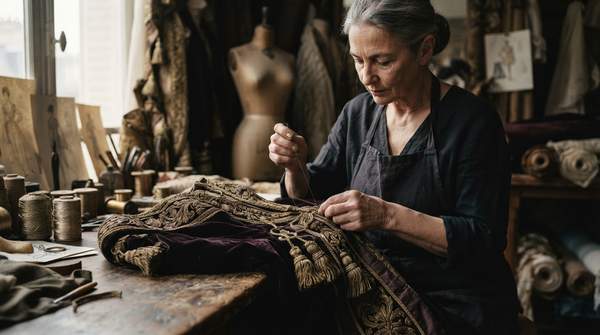
Passementerie in Haute Couture: How an Ancient Luxury Craft Became Integral to Fashion's First Great House
Passementerie, a traditional luxury craft of decorative trimmings, was intrinsically linked to the foundational principles of haute couture established by Charles Frederick Worth in 19th-century Paris. The article explores the symbiotic relationship between the craft's artisanal skill, luxurious materials, and status signaling, and the bespoke, exclusive nature of early high fashion.
Passementerie—decorative trimming such as tassels, fringes, cords, and braids, worked in silk and metallic threads—was not a random ornament that happened to appear on 19th-century couture garments. It was a craft whose defining attributes, luxurious materials, skilled handwork, and long association with aristocratic dress, aligned point for point with the founding principles of the haute couture system that Charles Frederick Worth established in Paris from 1858. Understanding that alignment, rather than merely cataloguing pretty trimmings, is what allows a discerning reader to see 18th- and 19th-century garments as documents of craft, economics, and status rather than as decoration alone. What is Passementerie? An Intricate Craft Defined The Fashion History Timeline at the Fashion Institute of Technology defines passementerie as "an additional accent or embellishment in silk or metallic threads, such as an embroidered braid, tassel or fringe." The term's meaning shifted with the…