The luxury compact and vanity case began as a man's practical travel kit and ended, by the 1930s, as one of the most eloquent symbols of female independence ever carried in a handbag. In Britain, these containers were originally designed for men, coming into fashion toward the end of the 18th century as finely crafted "dressing cases" fitted with compartments for cologne, shaving cream, combs and manicure tools, as the luggage-maker Globe-Trotter recounts. Two centuries later, jewelry houses such as Cartier and Van Cleef & Arpels were producing slimline, jewel-encrusted cases that women carried openly into restaurants and theaters. Understanding that transformation means tracing a clear chronology of function, materials and meaning.
From Utilitarian Travel Kits to Elegant Accessories: An Introduction
Objects made for personal preparation have always carried a double charge: they serve the most private domestic rituals, yet the finest among them announce social class and status. The Metropolitan Museum of Art's study of the dressing table observes that such furnishings range "from utilitarian pieces to serve our most basic domestic needs to matchless luxury objects that are also powerful statements about social class and status." The vanity case and the compact are the portable descendants of that tradition.
What makes their story distinctive is the reversal of audience. An accessory born in men's grooming culture became, within roughly a century and a half, an emblem of the modern woman — an object whose style, as one cultural historian of the American compact puts it, mattered as much as the powder and lipstick it held. The eras below trace that arc.
18th Century Origins: Men's Dressing Cases and Nécessaires
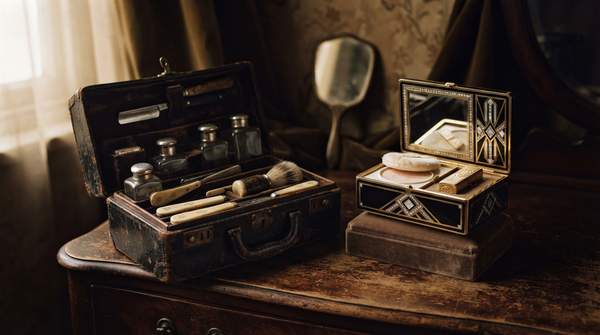
In late-18th-century Britain, the dressing case was a gentleman's possession: a finely crafted container of luxury materials and finishes, organized for the rituals of the toilette on the road. Globe-Trotter's history notes that although makeup vanity cases are now considered distinctly feminine, they were originally designed for men, with compartments for toiletries such as cologne, shaving cream, combs and manicure tools.
The same period saw the dressing table itself reach what the Metropolitan Museum describes as "the apogee of its evolution as a marker of social ascendance," exemplified by the work of Martin Carlin, a German-born cabinetmaker active in Paris in the late eighteenth century. The portable case and the stationary table shared a common logic: grooming was not merely maintenance but a performance of rank, conducted with instruments worthy of it.
19th Century Evolution: Victorian Ornate and Art Nouveau Forms
The Victorian era that followed pushed decorative excess to its height. Design historians characterize the period as one of ornate details — fussy, cluttered, intricate work across architecture, furniture and personal accessories alike. A vanity case of this sensibility was an object of dense embellishment, its surfaces crowded with the elaborate aesthetics that defined the age.
By the last decades of the century, reaction set in. As the Victoria and Albert Museum explains, many artists and designers were "filled with a passionate urge to revolutionise the tired historicism" of traditional design, and Art Nouveau emerged across several countries with broadly similar traits: natural forms including flowers, leaves, animals and insects, an emphasis on the fluidity of line, and the integration of structure and decoration. The vanity case absorbed these currents, its decoration loosening from Victorian density toward whiplash curves and organic motifs — a bridge between the heavy 19th century and the geometric clarity to come.
The Roaring Twenties and Art Deco: Women's Public Performance
The decisive break came in the 1920s. Women's burgeoning independence — it became socially acceptable for young women to smoke and apply makeup in public, in Globe-Trotter's account — imposed new requirements on the vanity case. The bulky models of the past gave way to portable kits that were sleek and slimline in design according to the Art Deco style, made by the eminent jewelry houses of the day and featuring mother of pearl, tortoise shell, jade and precious stones.
The American compact followed the same trajectory. Compacts first arrived on the fashion scene in the early 1900s and reached what the American Popular Culture archive calls "a crescendo of creativity in the 20s and 30s." By 1928, the Sears catalog devoted two pages to what it termed the "Modern Essential" — the accessory without which American women could not carry the 4,000 tons of face powder they consumed yearly. A 1928 Cartier vanity case in gold, platinum, enamel, diamonds, emeralds, rubies and onyx, similar to one owned by Jeanne Toussaint, shows the heights the form reached. British manufacturer Stratton, which began assembling imported powder boxes in Birmingham in 1923, was by the 1930s producing half the compacts used by the UK cosmetics industry.
Mid-20th Century: Material Shifts and Enduring Appeal
The interwar golden age could not last. The decorative compact, in the American Popular Culture account, "quietly passed out of day-to-day existence by the mid-1950s," its era defined by personal items that were "really made of metal and had the look of craft about them." The 1940s brought a shift from metal toward plastic, reflecting broader manufacturing change and widening access beyond the luxury market.
Yet at the top of the market, the great houses continued. Sotheby's notes that since the 1930s, jewelry houses including Van Cleef & Arpels, Bulgari, Tiffany, Cartier, Chaumet, Lacloche, Boivin, Mauboussin and Buccellati have all created styles of these precious cases, reflecting trends from Art Deco to Art Nouveau, Cubism to Bauhaus. A diamond powder compact made by Cartier in 1939 shows the form still flourishing at the decade's end.
Chronological Evolution of Luxury Compacts and Vanity Cases
The table below gathers the eras into a single sequence, so that any case you encounter can be placed by its function, materials and cultural role.
| Era | Key Characteristics & Function | Dominant Materials | Cultural Significance |
|---|---|---|---|
| Late 18th century | Men's "dressing cases" in Britain: finely crafted travel containers with compartments for cologne, shaving cream, combs, manicure tools | Luxury materials and finishes | Grooming as a marker of social class; parallel to the dressing table's peak as a symbol of social ascendance |
| 19th century (Victorian) | Ornate, intricate, heavily decorated design across personal accessories | Elaborate decorative surfaces | Embellishment as the dominant aesthetic of status |
| 1890s–circa 1905 (Art Nouveau) | Fluid lines, natural forms — flowers, leaves, animals, insects — with structure integrated into decoration | Not specified in the historical record reviewed | Revolt against "tired historicism"; design reform reaches the accessory |
| 1920s–1930s (Art Deco) | Sleek, slimline, geometric portable kits; compacts in elaborate shapes reach a "crescendo of creativity"; the "Modern Essential" | Mother of pearl, tortoise shell, jade, precious stones; gold, platinum, enamel, diamonds, emeralds, rubies, onyx | A "prop in a public performance" for the modern woman; socially acceptable public makeup; growing independence |
| 1930s onward (luxury houses) | Precious cases by Cartier, Van Cleef & Arpels, Bulgari, Tiffany and others, reflecting Art Deco, Cubism and Bauhaus trends | Precious metals and stones | Vanity case established as a high-status fashion object |
| 1940s–mid-1950s | Shift from metal to plastic; decorative compact fades from daily use by the mid-1950s | Plastic replacing metal | Broader accessibility; end of the interwar golden age |
Read as a sequence, the table shows two intertwined movements: a formal one, from Victorian density through Art Nouveau curves to Art Deco geometry; and a social one, from the gentleman's private kit to the flapper's public prop. The materials column tracks the same story — luxury finishes, then precious stones, then, finally, plastic.
Cultural Significance: Symbols of Independence and Status
The compact's deepest meaning lay in where it was used. As Kathy Lee Peiss writes in Hope in a Jar, "The young flapper adopted the compact as…a prop in a public performance." Applying powder at the dinner table was itself a small act of self-possession: Harper's Bazaar in July 1934 described the coveted compact as "The kind of compact you can pull out and make great show of at the dinner table." Virtually every woman in America had at least one, and the style of the compact was judged as important as its contents.
The luxury jewelers completed the transformation. By rendering the vanity case in gold, platinum and precious stones, houses like Cartier and Van Cleef & Arpels elevated a practical container into jewelry in its own right — an object that declared both wealth and modernity. The case designed to be displayed rather than hidden in a handbag, as the vintage-fashion archive Yakymour notes of the era, captures the spirit exactly: this was an accessory meant to be seen, because its owner was meant to be seen.
Identifying Historical Vanity Cases and Their Cultural Echoes
When you encounter a historical compact or vanity case, assess its design, materials and functional elements to place it within its correct era and understand its cultural significance. A fitted gentleman's case with grooming compartments points to the late 18th century; dense, intricate ornament to the Victorian decades; flowing naturalistic lines to Art Nouveau; and a sleek, geometric, jewel-set case to the Art Deco moment of female independence. The measurable test of this article's usefulness is your ability to accurately categorize a compact or vanity case as an 18th-century dressing case, a Victorian ornate piece, an Art Nouveau item, or an Art Deco symbol of female independence, based on its characteristics — and, in doing so, to read in its surfaces the social history it carried.
Sources
- History of the Vanity Case — GLOBE-TROTTER USA
- Metmuseum
- Art Nouveau – an international style — Victoria and Albert Museum
- Style in American Popular Culture — Americanpopularculture
- A History of the Vanity Case from Cartier to Boucheron — Sothebys.com
- Vanity Case – Yakymour