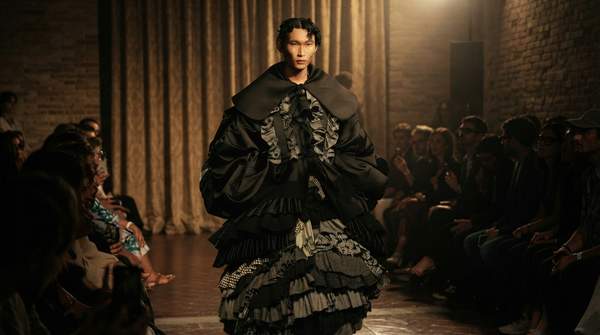
Before a single model steps onto the catwalk, a fashion show has already told its audience what kind of collection it is about to see. That message arrives not through fabric or silhouette but through the soundtrack. As the sound-focused essayist Isabelle Vuitton puts it, the lights have not changed and the set is still, but the music has started, "and that is enough." Sound has moved from backdrop to primary narrative instrument, and the strategies behind it are distinct enough to be named, compared, and decoded.
The Unseen Overture: Sound as a Fashion Show's First Impression
Fashion is conventionally taught as a visual discipline, described through fabric, silhouette, construction and colour. Yet anyone who has sat through a runway show knows the sequence of perception runs the other way. As Vuitton observes, "the first impression is never visual. It is sonic. The soundtrack lands before the clothes do, and it shapes everything that follows."
The practical mechanism is straightforward: the right runway music establishes tone, pace and emotional resonance, functioning as what one industry analysis calls a narrative voice that guides audience perception rather than a background element. The genre choice does interpretive work before a garment is seen — a minimalist collection benefits from ambient or ethereal soundscapes, while a streetwear show might call for pulsating beats and dynamic loops.
This primacy has been reinforced by livestreaming. Even when remote viewers cannot inspect the delicacy of a thousand stitched appliqués in person, hearing the sound in real time welcomes them into the designer's fantasy more fully than ever before, as ELLE's Alexandra Hildreth reports on the spring/summer 2026 season. The soundtrack, in other words, is now part of the collection's public identity.
Crafting the Sonic Narrative: Approaches to Runway Sound Design
Not every show builds its sound the same way. Four broad strategies dominate contemporary practice, and they differ in creative process as much as in effect. The table below categorizes them by how they are made and what they are meant to achieve.
Comparing Runway Sound Design Strategies
| Approach | Creative Process | Typical Use Case | Narrative / Emotional Impact |
|---|---|---|---|
| Bespoke composition ("sonic couture") | Designer and sound designer translate the collection's concept into a unique score, sometimes requiring new recording methods and significant time and resources | Debut collections and shows where the soundtrack must be as personal as the clothes | Infuses the show with emotional resonance and creates an immersive, multisensory experience tied directly to the collection's meaning |
| Live performance | A curated live act synchronized in real time with the unpredictable flow of the runway | Shows seeking unrepeatable moments that cut through digital noise | Captures attention, sparks emotion and keeps the audience engaged; adds rhythm and soul beyond visual aesthetics |
| Curated playlist / DJ mix | Sound designers select and sequence existing tracks to match the collection's mood and brand identity | Shows leaning on familiar or evocative songs to steer perception | Sets the tone and guides the audience through the collection's story via the resonance of the chosen tracks |
| AI-assisted sound design | AI tools generate custom instrumental tracks from text prompts, loop seamlessly and reduce manual editing | Teams that need fully produced, vocal-free music matched to a show's tempo and theme | Extends creative freedom and iteration speed rather than defining a distinct emotional register of its own |
Bespoke work sits at the artisanal end of this spectrum. For Pierpaolo Piccioli's debut at Balenciaga, the designer worked with Quintard and Miraval Studios on a "sonic couture" score built around an unusually personal source — his own heartbeat, which the collection's title referenced. As Quintard told Hildreth, "It's unique, it's emotional, it took time, it took resources, it took new ways of recording hearts to be able to broadcast it online or in a set where you have hundreds of people viewing the show." The score then layered that motif under orchestrated versions of songs including Lauryn Hill's rendition of "Can't Take My Eyes Off of You."
Quintard frames the craft in explicitly couture terms: "It's exactly the same with sound" as the intricate handwork of the couture houses — details that might not strike you from far away, but reveal their depth as you get closer. Live performance, by contrast, trades that control for presence. In Candice Martini's analysis for The Fashion Globe, a well-curated live act elevates a show into something unforgettable by capturing attention and sparking emotion, adding unrepeatable moments and real-time connection in a way screens cannot.