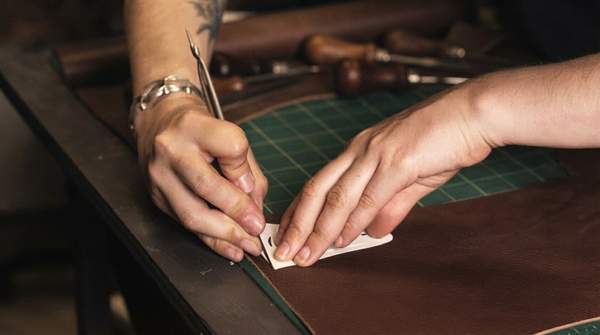
Traditional bespoke shoemaking is a sequential craft in which each stage builds on the one before it: the client's feet are measured in detail, a wooden last is carved to those measurements, a paper pattern is cut from that last, a trial shoe is fitted and revised, and only then is the final shoe lasted and hand-welted. The custom last is the foundation of everything—unlike customized ready-to-wear, which changes leather, color and details but not the underlying form, true bespoke begins with a three-dimensional model of the client's own foot.
The Bespoke Shoemaking Journey: An Overview
The craft follows the methods of traditional English hand-welted shoemaking, as practised by makers such as Canons, whose workshop describes how "whenever a new bespoke last is made… the shoes are effectively made twice": a separate pair of trial shoes is produced, fitted, adjusted, and then discarded so the final pair can be cut and made afresh. The process is therefore not a single act of construction but a chain of dependent stages—measurement, last-making, pattern cutting, trial fitting, lasting and welting, and finishing—each of which exists to translate the client's foot into a durable, individual form. What follows traces that sequence in order, explaining what happens at each step and why it cannot be skipped.
Stage 1: Consultation and Precise Measurement
Everything begins with an examination of the feet themselves. At Canons, approximately thirty minutes are spent examining both feet, taking detailed measurements, preparing outlines and recording observations about their characteristics and fitting requirements (S1:P3). During the consultation, clients also discuss their preferred styles, select leathers, and consider shoe details (S1:P3). These initial measurements and observations are crucial for creating the bespoke lasts (S1:P3).
The shoemaker also studies how the foot behaves in motion: the Italian Shoe Factory notes that this includes how a foot rolls when one walks and how this will affect factors such as heel height. The consultation is thus both a static and a dynamic assessment—the foot at rest and the foot in movement—because the last must accommodate both.
Stage 2: Crafting the Custom Last
The last is the wooden form around which the shoe is constructed, and it determines much of the fit, shape and proportions of the finished pair. Canons carves a beechwood last for each foot by hand, using its own last-making techniques. Bondeno's Charles Kelso describes the creation of a custom shoe last as "one of the most crucial steps in crafting a pair of perfectly fitting shoes," a three-dimensional model of the client's foot.
This is the decisive distinction between bespoke and customized ready-to-wear: as Bondeno explains, customizing a ready-to-wear shoe changes its leather, color and details, but not its last. The bespoke last is retained throughout the process—the Italian Shoe Factory notes it is placed inside the shoe so the shoe can be modelled around it, and used again near completion to confirm the final fit matches the original design.