Passementerie—decorative trimming such as tassels, fringes, cords, and braids, worked in silk and metallic threads—was not a random ornament that happened to appear on 19th-century couture garments. It was a craft whose defining attributes, luxurious materials, skilled handwork, and long association with aristocratic dress, aligned point for point with the founding principles of the haute couture system that Charles Frederick Worth established in Paris from 1858. Understanding that alignment, rather than merely cataloguing pretty trimmings, is what allows a discerning reader to see 18th- and 19th-century garments as documents of craft, economics, and status rather than as decoration alone.
What is Passementerie? An Intricate Craft Defined
The Fashion History Timeline at the Fashion Institute of Technology defines passementerie as "an additional accent or embellishment in silk or metallic threads, such as an embroidered braid, tassel or fringe." The term's meaning shifted with the centuries, and the definitions preserved in that reference trace the shift precisely: citing The Dictionary of Fashion History (2010), it notes that in the 16th and 17th centuries passementerie denoted "ornamental braids and other trimmings of gold and silver, silk or cotton threads," while by the 19th century it had become "colourful braids and fringes decorated with beads, silk and metallic threads."
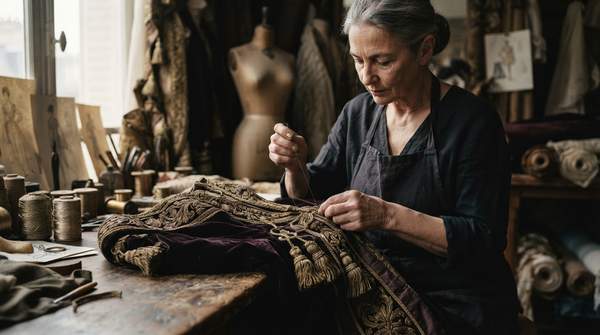
Writers at the design house Paolo Moschino describe the craft in similar terms, as "the art of creating decorative trimmings, such as tassels, fringes, and cords," noting that it was long "a highly valued skill among artisans." The definition that matters for fashion history, then, is consistent across sources: passementerie is applied, three-dimensional ornament, distinct from flat embroidery, made from costly thread and beadwork and demanding specialized hand skill.
The Diverse Forms of Passementerie: Tassels, Fringes, and More
Within the umbrella term, the primary forms recur across the sources. Tassels, knotted pendants of thread, were historically supplied for both dress and furnishings; the Wikipedia account of the trade records that in England specialist merchants known as "silkmen" furnished passementerie, including one Benjamin Henshawe, who provided "a variety of lace and tassels for clothing and interior decoration" to Anne of Denmark and Henrietta Maria. Fringes, along the 19th century's own definition, were braided edges "decorated with beads, silk and metallic threads," giving weight and movement to hems, bodices, and epaulettes. Cords, twisted or braided lengths, served both structurally, as piping and frogged fastenings on military dress, and decoratively as trimming.
Joe Sayer, writing for Paolo Moschino, adds the historical breadth that made these forms available to the couturiers: the craft flourished during the Renaissance, when it adorned "clothing and furnishings," and reached "its peak of popularity" in the 18th and 19th centuries, when "intricate trimmings adorn[ed] everything from military uniforms to ball gowns." A garment form that matured on uniforms and court dress was thus fully developed, and deeply prestigious, precisely when couture emerged.
A Legacy of Luxury: Passementerie's Historical Status
The same Wikipedia account makes the social function explicit: passementerie worn on clothing "was for a long time reserved for the elites as a sign of social distinction among royalty, aristocracy, religious, and military." This is the crucial inherited meaning. By the 18th century, gold-and-silk braid on a coat or gown signaled rank before it signaled taste; the quantity and quality of one's trimming was legible as a statement of station.
That status system, notably, was already weakening when couture arrived. The same source records that "since the 18th century, the use became largely obsolete with the simplification of clothing," and that mid-20th-century production saw "a marked decline." Passementerie was therefore a mature, prestigious, and increasingly rare craft in the mid-19th century, the surviving branch of an aristocratic tradition that simplified dress had largely stripped away.
The Birth of Haute Couture: Principles of a New Fashion System
Haute couture began, by the standard account used by Cambridge University Press's chapter "The Origins and Development of Haute Couture, 1858 to Now," with the Englishman Charles Frederick Worth (1825–1895) in Paris. Its defining features were structural as much as aesthetic: the House of Worth and the grand couturiers who followed "operated under a similar business model whereby unique seasonal designs would be created by the head of the house, or auteur, and made to order for clients by in-house ateliers."
The system depended, in that account, on Paris as a "capital" of fashion with "its network of skilled artisans and material luxury," and it thrived on "the expanded patronage cultivated by the House of Worth," which the Metropolitan Museum of Art's essay on haute couture notes was "still dependent upon the considerable support of Empress Eugénie." Couture fused novelty with the old dressmaking crafts—"the arts of dressmaking, tailoring, and crafts constituent to apparel and accessories," as the Met puts it—into a new, bespoke, trend-setting system serving an exclusive wealthy clientele.
Passementerie and Haute Couture: A Symbiotic Relationship
Mapping the craft against the system explains why the pairing was inevitable rather than incidental. Each row below takes a defining attribute of passementerie and shows the corresponding principle of early haute couture:
| Attribute | Passementerie | Haute Couture (from 1858) |
|---|---|---|
| Craftsmanship | A "highly valued skill among artisans," producing trimmings by hand | Bespoke garments made to order by in-house ateliers within a "network of skilled artisans" |
| Materials | Silk and metallic threads, beads and pearls on braids and fringes | "Material luxury" as a defining condition of the Paris fashion capital |
| Social status | Reserved for elites; a "sign of social distinction among royalty, aristocracy, religious, and military" | An exclusive, wealthy clientele, expanded through Worth's patronage and Empress Eugénie's support |
| Design originality | Distinct, artisanal trimmings on high-status garments at its 18th–19th-century peak | "Unique seasonal designs" created by the house's auteur and dictated as trends |
The mapping shows the alignment working in both directions. Couture needed artisans of exactly passementerie's kind, because its business model was hand-crafted, one-of-one garments for elite clients; passementerie, an aristocratic craft losing its traditional homes to simplified dress, found in the couture atelier a new and sustaining patron. The trimming carried the same silk, bead, and metallic-thread richness that defined couture materials, and it brought with it a ready-made visual vocabulary of rank. When a Worth client commissioned a ball gown finished in beaded fringe, the ornament simultaneously displayed bespoke handwork, costly material, and inherited aristocratic meaning, the entire value proposition of the couture garment, rendered in thread.
This synthesis of the two timelines is an explanatory reading drawn from the sources rather than a causal claim any single passage makes explicitly: the craft's attributes and the system's principles are each independently documented, and their correspondence is what the evidence, read together, establishes.
Appreciating the Enduring Legacy of Passementerie in High Fashion
To fully appreciate haute couture garments of the 18th and 19th centuries, then, discerning enthusiasts should look for passementerie elements and read them as evidence of three things at once: the bespoke hand-craftsmanship of the atelier system, the luxury of silk, metallic thread, and bead materials, and the wearer's place in an elite social order that passementerie had signaled for centuries. A tassel is never merely a tassel on such a garment; it is the philosophy of the house made visible.
A concrete test of that understanding is available to any reader in a museum gallery or archival image: identify the specific forms, tassel, fringe, cord, or beaded braid, on a Worth-era or earlier elite garment, and then articulate how each reflects the founding principles of the couture system, skilled artisan labor, luxurious materials, exclusive patronage, and unique design. A reader who can complete that exercise has grasped passementerie's historical role in high fashion, not as an accessory to couture, but as one of its constitutive crafts.
Sources
- passementerie — Fashionhistory
- Passementerie: The Intricate Craft of Decorative Trimmings — Paolo Moschino Ltd
- Passementerie - Wikipedia
- The Origins and Development of Haute Couture, 1858 to Now (Chapter 37) — Cambridge Core
- Metmuseum