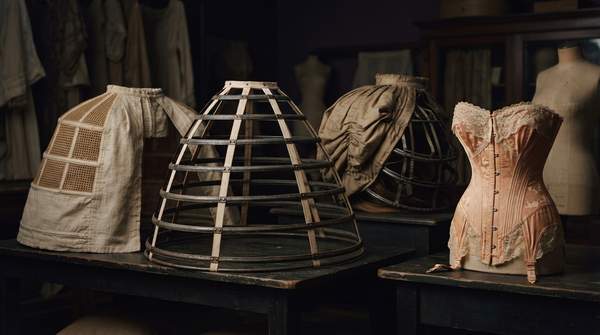
Every era's fashionable female shape was, in a literal sense, manufactured. From the wide-hipped grandeur of the eighteenth century to the straight, androgynous line of the 1920s, Western women's silhouettes were dictated less by the body than by the hidden structures beneath the gown. Four undergarments did most of that work: panniers spread the eighteenth-century skirt sideways, cage crinolines inflated the Victorian skirt into a bell, bustles threw the 1870s and 1880s silhouette backward, and the shortened corset of the 1920s smoothed the body into a slim, tubular line.
H. Kristina Haugland, associate curator of Costume and Textiles at the Philadelphia Museum of Art, frames the point well: the history of feminine undergarments "reflects changing ideals of women's figures and societal roles," revealing that ideas of beauty, hygiene, modesty and respectability are "remarkably transitory." To read fashion history accurately, one must first read the engineering underneath.
18th-Century Panniers: Engineering Width and Grandeur
The story of structural underwear does not begin in the Victorian era. The hoop-skirted shapes of the mid-nineteenth century had direct ancestors in the 16th- and 17th-century farthingale and, crucially for this discussion, the 18th-century pannier. As historical accounts of the crinoline note, these earlier garments performed a recognizably similar mechanical function: they enabled skirts to spread ever wider and more fully, projecting the fabric away from the wearer's legs in a rigid, governed arc.
The fashionable eighteenth-century silhouette that panniers produced was one of extraordinary lateral width—a wide, bell-shaped skirt, or in its most exaggerated courtly forms, an "enormous backside" that could force wearers to turn sideways through doorways. The garment's structural principle was the same one later industrialized for the crinoline: a cage or hoop of firm material carried the weight of the skirt's fabric at a fixed distance from the body, so the gown's shape depended on the frame rather than on petticoats of accumulating cloth.
This is the essential interpretive lesson for the student of costume: when an eighteenth-century gown appears impossibly wide at the hip, the width is not cut into the dress itself. It is provided by a support garment underneath, and the gown is merely the visible skin over that scaffold. The same logic governs every silhouette examined below.
Mid-19th-Century Crinolines: The Bell-Shaped Revolution
By the 1850s, the term "crinoline" referred first to horsehair petticoats and then to the hoop skirts that replaced them in the mid-1850s. The decisive innovation arrived in April 1856, when R.C. Milliet patented the steel-hooped cage crinoline in Paris, with a British agent following a few months later. The design became extremely popular and was then mass-produced on an industrial scale, with factories across the Western world turning out tens of thousands per year.
The engineering challenge the cage solved was one of competing demands: the crinoline had to be rigid enough to support the skirts in their accustomed shape, yet flexible enough to be temporarily pressed out of shape—through a doorway, for instance—and spring back afterward. Steel met both requirements and became the most popular material, though alternatives including whalebone, cane, gutta-percha, and even inflatable caoutchouc (natural rubber) were all tried. The inflatable version was short-lived; the hoops punctured and collapsed easily, and the brimstone used in rubber manufacture made them smell unpleasant.
At its widest point, the crinoline could reach a circumference of up to six yards—a measurement that conveys the true scale of the Victorian bell. Its function, in the words of the historical record, was the same as that of the farthingale and pannier before it: to enable skirts to spread wider and more fully, but now in a symmetrical, dome-like bell rather than a laterally extended oval. The silhouette was audibly modern in its means—patented, factory-made steel—while utterly traditional in its ambition: maximum skirt.