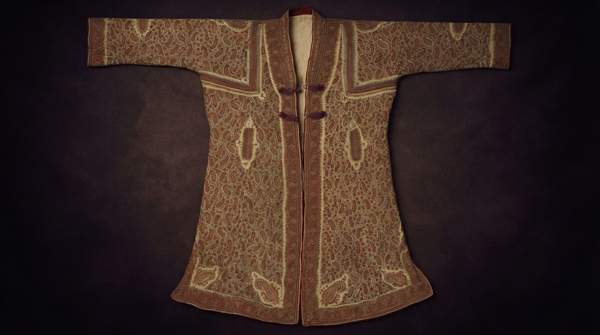
The frog closure—the braided loop-and-knot fastening that runs like decorative piping across a jacket's front—descends from two distinct lineages: the Chinese pankou, an ornamental toggle rooted in traditional Chinese dress, and European military frogging, the elaborate braidwork of hussar uniforms. Understanding which tradition a given closure belongs to, and whether it actually fastens anything, tells the reader a great deal about the garment it adorns.
The Enduring Appeal of Frog Closures
A frog closure is, at its simplest, a fastening in which a loop on one edge of a garment opening hooks over a knot or button on the other. Sewing instructor Doina Alexei describes the traditional arrangement: frogs are used in pairs, with one piece serving as the button loop on one edge of the opening and an identical piece acting as a decorative accent beneath the button on the opposite edge, so that when the garment closes, the two halves meet to form a braided design. The construction material varies widely, from cording to custom-made fabric tubing, which is precisely what gives the closure its dual character: the same braided cord can serve as a working clasp or as pure surface ornament.
This ambiguity between function and decoration is the closure's defining trait. Frog closures can be constructed from a variety of materials, and their braided geometry allows them to carry visual weight across a garment's front while performing—or merely implying—the work of fastening. That flexibility explains their persistence: they appear on cheongsam, on military dress jackets, and on contemporary coats alike, sometimes doing the work of a button and sometimes standing in for one.
Chinese 'Pankou': Intricacy and Symbolism
The Chinese tradition of the pankou is the older of the two. ApparelX News, an apparel-industry publication, traces the Chinese frog closure to a clasp attached to traditional Chinese clothing, used on upper garments such as shirts and blouses by tying a string into a ball and looping the other end to hook over it; the same account places its first appearance in fifth- to seventh-century China. A more conservative dating appears in reference material describing the pankou as originating at least as early as the Song dynasty (960–1279 AD), with materials described as diverse, including silk.
What distinguishes pankou is its integration with the garment itself. Chinese frog closures are often made from the same fabric as the garment, producing a seamless, tonal effect, and the designs tend toward intricacy and symbolic meaning—floral pankou, for instance, are typically used on the cheongsam. The closure is primarily functional, securing the garment's opening, yet its construction from self-fabric and its knotted motifs make it inseparable from the garment's overall aesthetic. The craft remains demanding: ApparelX News notes that while frog buttons have grown popular, the number of craftsmen able to make them by special order has declined considerably, with ready-made production shifting largely to China.
European 'Frogging': Military Grandeur and Status
The European tradition took shape in military dress. Frogging—the use of braided frog fasteners as a design detail—became prominent on Western European military uniforms between the seventeenth and nineteenth centuries, particularly those of the Hungarian Hussars. The transmission route is genuinely uncertain: the hussars possibly adapted the fastener from earlier Chinese or Ottoman styles, or may have independently developed an analogous fastener, and the available secondary sources do not settle the question. From the military, the style spread to civilian clothing of both genders—overcoats, spencers, and pelisses.
Where pankou whispers, European frogging shouts. Doina Alexei notes that European military uniforms used rich frog fasteners sometimes made of gold and other high-grade materials, chosen conspicuously to signify rank and status. The braiding often extends in complex patterns across the chest and sleeves, prioritizing visibility over the subtle elegance of the Chinese tradition. The two traditions thus represent opposite answers to the same construction problem: one embeds the closure into the fabric of the garment, the other lays a contrasting, status-laden braid on top of it.
Comparing Chinese Pankou and European Frogging
The table below sets the two traditions side by side across the dimensions that matter for identification: where each came from, what it is made from, how it looks, and what it does on the garment.
| Dimension | Chinese Pankou | European Military Frogging |
|---|---|---|
| Historical origin | Traditional Chinese apparel; dated to at least the Song dynasty (960–1279 AD), with one account placing first appearance in 5th–7th century China | 17th–19th century European military uniforms, especially Hungarian Hussars; possibly adapted from Chinese or Ottoman styles or independently developed |
| Typical materials | Often the same fabric as the garment itself for a seamless look; also silk and other diverse materials | Contrasting braids and cords, sometimes gold and other high-grade materials |
| Design style | Intricate and symbolic, with subtle elegance; floral motifs typical on cheongsam | Elaborate and conspicuous, extending in complex patterns across chest and sleeves to signify rank and status |
| Primary use | Primarily functional fastening of garment openings, with a decorative role | Both functional and highly decorative; ornamental use, often concealing another closure, is very common |
Read the table as a diagnostic tool rather than a taxonomy: a tonal, self-fabric closure with a subtle knotted motif points toward the pankou lineage; a contrasting metallic braid sprawling across a jacket front points toward military frogging. Many modern garments blend the two, which is why material and placement, not any single feature, drive identification.
Functional Fastener vs. Decorative Embellishment
The most practical thing to know about a frog closure is that it may not be a closure at all. Although frogs are functional by nature, Doina Alexei observes that it was—and remains—very common to use them for decorative purposes only, with another functional closure underneath the braiding: snaps, buttons, or hook-and-loop tape hidden beneath the ornament. Historically, frogs were sometimes used excessively on a garment for strictly ornamental purpose, with no fastening role whatsoever.
This has real consequences for garment design and fit. A working frog closure must be engineered with precise loop-and-knot alignment, because the pair must meet and hold under strain; a decorative frog can be placed anywhere the designer pleases, since hidden snaps or buttons carry the actual load. The braided surface becomes, in effect, a drawn line the designer controls independently of the garment's structure. When a garment's front appears to close with frogs but feels suspiciously easy to fasten, the braiding is likely ornament laid over a concealed closure.
Identifying Frog Closures in Modern Design
When encountering a frog closure, consider its design, material, and placement to discern its historical influence and primary purpose. A closure in self-fabric with a compact, symbolic knot likely draws on the pankou tradition and probably fastens the garment; a contrasting gold or braid frog sprawling across a military-style jacket likely descends from hussar frogging and may be purely ornamental, with snaps or buttons doing the real work beneath. The measurable indicator of success is simple: the reader can identify whether a frog closure on a garment is primarily functional or decorative, and recognize elements of Chinese pankou or European frogging in its style.
Sources
- How To Design, Make And Sew A Frog Closure By Hand — Doina Alexei
- Frog (fastening) - Wikipedia
- Chinese Frog Closure: Frog fasteners — ApparelX News