When a high jewelry necklace drapes across the collarbone as if poured rather than fastened, the fluidity is not luck—it is mechanism. Three engineered approaches dominate articulated fine jewelry: multi-axis hinges that flex in two dimensions, slot-and-tab linkages that slide within defined channels, and snake chains built from tightly fitted rings. Each buys its movement differently, and each carries its own maintenance burden. Understanding which one a piece uses tells you how it will behave on the body, how it will age, and where it will eventually need a jeweler's attention.
The Engineering Behind Fluidity: What is Jewelry Articulation?
Articulated jewelry is simply jewelry with moving parts—segments joined so the piece bends, drapes, or swings rather than sitting rigid. The engineering challenge, as the CAD design specialists at CADCAM Designs describe it, is that successful articulation requires balancing freedom of movement with structural stability. Every pivot must allow precise angular motion while maintaining alignment and structural integrity, and pivot spacing, tolerances, and clearances must be refined for casting, assembly, wearability, and long-term durability.
Two principles recur across the craft. The first is the controlled pivot point: a deliberate joint, engineered to a measured tolerance, rather than the incidental flexibility of an ordinary chain. The second is graduated geometry—varying the size and weight of links along the piece so that it stays where the designer intended. Rodtanaka's technical anatomy of high jewelry necklaces explains that structured collars and rivière necklaces use internal mechanical hinges combined with graduated link sizing specifically so the piece lies flat without flipping, twisting, or pinching skin during movement.
Key Articulation Mechanisms in High Jewelry
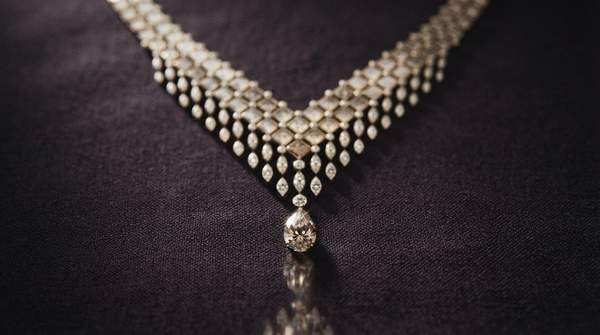
The multi-axis hinge is the most demanding mechanism in jewelry fabrication. In high-end collar necklaces, Rodtanaka describes hidden micro-hinges connecting each individual gemstone bezel or metal plate, allowing two-dimensional movement: flexing inward around the neck's circumference while simultaneously tilting outward to lie flat across the sloping upper chest. CADCAM Designs calls precision hinges the hardest mechanism to execute well, with the goal of seamless single-axis rotation and zero visible gap—the hallmark of true haute joaillerie craftsmanship.
Slot-and-tab linkages take a different route. Interlocking components slide or pivot within defined channels, allowing controlled movement in one or two directions and creating the fluid drape characteristic of fine chain work, with gravity-secured closures ensuring invisible connections. Snake chains, by contrast, are built from small, tightly fitted round or curved metal rings linked side by side, forming a smooth, flexible tube with a polished, scale-like surface that moves like snake skin. The jewelry glossary at Lily Dia notes that fish, lizard, and leaf motifs are favorites precisely because their individual scales or segments can be hinged for lifelike movement.
Comparative Guide to High Jewelry Articulation Mechanisms
Setting the three mechanisms side by side reveals the trade-offs each represents. The table below compares them across range of motion, visual integration, typical application, and durability, drawing on the technical descriptions above.
| Mechanism | Range of Motion | Visual Integration | Typical Application | Durability and Maintenance |
|---|---|---|---|---|
| Multi-axis hinges | Two-dimensional movement—flexes inward around the neck while tilting outward to lie flat; designed for ergonomic draping | Hidden micro-hinges between gemstone bezels or plates; often paired with the concave curve principle to keep stones facing outward | High-end collar and rivière necklaces | Hinge points are the most vulnerable areas; require periodic checking and lubrication, especially on antique pieces where metal may be fatigued |
| Slot-and-tab linkages | Controlled movement in one or two directions; components slide or pivot within defined channels | Interlocking design aims for controlled flexibility with a visually continuous appearance; gravity-secured closures keep connections invisible | Fine chain work requiring fluid drape | Controlled pivots maintain alignment and structural integrity; general articulated-jewelry care applies |
| Snake chains | Flexible tube that moves like snake skin, bending smoothly along its length | Polished, scale-like surface with a smooth, continuous appearance | Snake chains, flexible bangles, swinging shoulder dusters, statement necklaces with interlocked panels | Well-made articulated pieces are generally durable; specific snake-chain vulnerabilities are not detailed in the available guidance, so general articulated-jewelry care applies |
The comparison shows the essential trade-off: the more precisely a mechanism controls movement—hinges—the more moving parts it introduces and the more attention those parts demand. Snake chains achieve fluidity through sheer repetition of simple rings, while linkages occupy the middle ground of controlled, channeled motion.
The 'Concave Curve Principle' and Anti-Flipping Design
Among the most elegant solutions in articulated design is one that addresses not flexibility but presentation. Rodtanaka describes the concave curve principle, noting that a flat metal band on a sloped chest tends to buckle or flip when the wearer moves their shoulders. To prevent this, structured chokers are designed with an anatomical concave interior curve.
The principle works alongside graduated link geometry. To prevent a heavy statement necklace from shifting backward or bunching at the sides of the neck, links are engineered larger and heavier at the central focal point, tapering systematically toward the rear clasp. This center-weighted geometry locks the piece in position along the sternum. The result is a piece that not only moves with the body but keeps its gemstones oriented outward—movement in service of the intended aesthetic, rather than at its expense.
Maintaining Your Articulated Jewelry: A Collector's Guide
Well-made articulated pieces are surprisingly durable, according to Lily Dia's guidance, but hinge points are the most vulnerable areas. Owners should avoid catching pieces on fabric and have hinges checked and lubricated periodically by a jeweler—especially on antique pieces, where the metal may be more fatigued. Repairs are more involved than for solid pieces because the jeweler must work around the moving parts, and replacing a broken hinge requires matching the original dimensions, so experience with the style matters.
The smallest components deserve the closest attention. Just Brilliant, writing on articulation pins in diamond jewelry, observes that pins connect moving parts and that their small scale makes them easy to overlook, yet their fit and condition influence how the elements move together. The practical protocol it suggests: ask which parts are intended to move and how that movement is limited; compare the actual jewel gently rather than forcing a hinge beyond its range; and if a joint begins to feel loose, stiff, or uneven, record the change and request an inspection.
Ensuring the Longevity and Fluidity of Your Articulated Jewelry
Regular professional inspection and appropriate handling are crucial for maintaining the intricate movement and durability of high jewelry articulation mechanisms. The measurable indicator of a healthy piece is the absence of stiffness, looseness, or visible gaps in joints, and consistent smooth movement during wear. Check your articulated jewelry against that standard each time you wear it, and schedule a jeweler's inspection the moment a joint deviates from it—caught early, a fatigued hinge or worn pin is a service; ignored, it becomes a repair.
Sources
- The Art of Articulation | Engineered Movement in Fine Jewelry — Cadcamdesigns
- Anatomy of High Jewelry Necklaces: Ergonomic Draping, Clasp Mechanics, — Rodtanaka
- What Is Articulated Jewellery? Moving Parts Explained — LILY DIA
- Articulation Pins in Diamond Jewelry: A Small Part With a Large Role — Just Brilliant