High jewelry's most celebrated collections have rarely invented their visual language from nothing; they have borrowed it, with striking fidelity, from the art movements of their moment. The clearest documented cases are Cartier and Van Cleef & Arpels, both of which translated the geometric discipline of Art Deco into jewels in the 1920s, and Bvlgari, which turned to the Pop Art culture of the 1980s in its Wild Pop high-jewelry collection. This comparative analysis traces how each house moved from an artistic vocabulary to concrete motifs, materials, and techniques—and how to recognize those influences when you see them.
Introduction: Art Movements as Muse for High Jewelry
The relationship between jewelry and the fine arts has been structural rather than incidental. Writing on jewellery inspired by actual artworks, Prestige's coverage records the view of Odet—a commentator cited in that piece—that the Art Deco movement, following the 1925 Exposition Internationale des Arts Décoratifs et Industriels Modernes in Paris, "defined the jewels of Cartier and the Bijoutiers-artistes during the 1920s." The same account observes that art still strongly inspires jewellery today, pointing to Bvlgari's Wild Pop collection as a contemporary example. The pattern, then, is continuous: a movement crystallizes in painting, architecture, or the decorative arts, and the great houses translate its principles into wearable form. What changes is the movement—and with it, the geometry, palette, and craftsmanship that follow.
From Organic Curves to Geometric Precision: Art Nouveau vs. Art Deco
Understanding Art Deco jewelry begins with what it rejected. Estate Diamond Jewelry's survey of jewelry eras describes Art Deco as "characterized by a distinct shift in design motifs, departing from the organic forms of Art Nouveau," with common motifs "marked by geometric precision, symmetry, and a sense of opulence." Triangles, rectangles, and circles appeared prominently, often arranged in intricate patterns conveying order and sophistication, alongside Egyptian and architectural influences—pyramids, chevrons, and stepped designs.
The Maison's own art-historical corpus, The Collection Van Cleef & Arpels, frames the transition similarly: Art Deco was "an art movement that emerged in reaction to Art Nouveau" and influenced all the visual and applied arts from the early twentieth century through the Second World War. Windsor Jewelers' account of the era's finest jewelers adds the cultural context: having surfaced after World War I, the movement reflected a desire to shift from fluid, nature-inspired designs to "more modern, daring, simpler, and cleaner shapes." The shift from organic curves to geometric structure, in other words, mirrored the broader movement toward modernity in the decorative arts—a qualification worth holding in mind as the house-specific examples unfold.
Cartier's Art Deco Legacy: Elegance and Modernity
Cartier's Art Deco chapter is inseparable from the 1925 Paris exposition that gave the movement its eventual name. According to the account Prestige attributes to Odet, the movement "defined the jewels of Cartier and the Bijoutiers-artistes during the 1920s"—a strong claim, positioning the house not as a follower of the style but as one of its principal exponents in jewelry. The term itself arrived later: as The Collection Van Cleef & Arpels notes, "Art Deco" was posthumously attributed by Bevis Hillier in his 1968 book on the style of the 1920s and 1930s, in reference to the 1925 exposition.
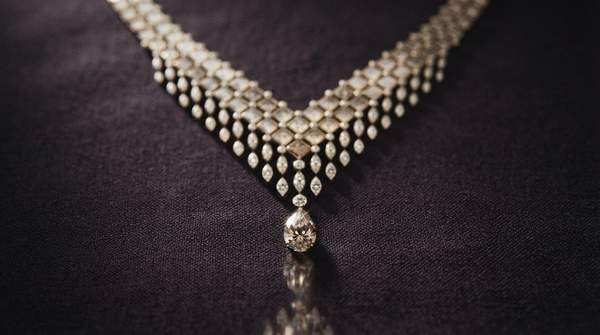
What that meant in practice was the vocabulary described above—geometric precision, symmetry, and opulence—executed at the highest level of craftsmanship. Windsor Jewelers' survey of the era identifies Cartier among the period's famous and influential jewelers and innovators, and characterizes the style as encapsulating "the epitome of elegance and craftsmanship at the time." For the reader learning to spot the influence, Cartier's Art Deco work is the benchmark against which the movement's jewelry translation is measured: clean geometry, ordered pattern, and the exotic-modern motifs the era favored.
Van Cleef & Arpels: Art Deco's Geometric Artistry
Van Cleef & Arpels approached the same movement through its own synthesis of influences. The house's collection scholarship records a "strong interest in non-European arts" cohabiting with reference to the French tradition, an interest boosted by international exchange in the early twentieth century—precisely the period when the Ballets Russes was giving its first performances in Paris. This cosmopolitan appetite fed directly into geometric designs and symmetrical layouts, with the house notable for collections featuring emeralds, onyx, and diamonds in geometric styles.
Technically, the Maison's defining contribution to the era was the Mystery Set technique, which Windsor Jewelers calls "a celebrated innovation and a true hallmark of the era," alongside the exceptional creativity and minute craftsmanship the house is known for. Van Cleef & Arpels' designs were, in that account, "an emblem of the Art Deco period." The house's narrative tradition also began here: its ongoing line of narrative bracelets originated with the 1920s Egyptian Revival, tying its Art Deco output to the same fascination with the exotic that shaped the movement's motifs. A century later, the connection remains explicit—both Boucheron and Van Cleef & Arpels released Art Deco-inspired high jewelry collections in 2021 to mark 100 years since the movement began.
Bvlgari's Wild Pop: A Bold Interpretation of Pop Art
If Art Deco demonstrates how a movement's discipline translates into structure, Bvlgari's Wild Pop shows how a movement's irreverence translates into exuberance. According to Prestige's account, the Wild Pop high-jewelry collection celebrates 1980s Pop-art culture and is heavily influenced by the works of Andy Warhol. The collection stands as evidence that art still strongly inspires jewellery today, with Pop Art serving as a distinctly modern influence rather than a historical one.
The contrast with the Art Deco houses is instructive. Where Cartier and Van Cleef & Arpels responded to a movement of geometric order—symmetry, stepped motifs, restrained opulence—Bvlgari responded to a movement of bold, popular imagery and vivid color. The same Prestige piece situates Wild Pop within a broader contemporary current of art-inspired jewellery, alongside Russian jeweller Ilgiz F's Iris rings inspired by flowers in Monet's paintings and Tiffany & Co's Seurat Bracelet paying homage to the founder of pointillism. Prestige also records Odet's observation that contemporary designers are imparting a "cool" factor to jewellery inspired by art—a sensibility Wild Pop embodies.
Comparative Framework: Art Movements in High Jewelry
Setting the three houses side by side reveals how differently a movement's principles can be expressed. The table below juxtaposes the design motifs and techniques each house used to translate its chosen movement into high jewelry, providing an at-a-glance guide to recognizing these influences in specific pieces.
| Jewelry House | Art Movement | Key Design Motifs | Notable Techniques or Examples |
|---|---|---|---|
| Cartier | Art Deco (1920s) | Geometric precision, symmetry, opulence; Egyptian and architectural motifs such as pyramids, chevrons, and stepped designs | Jewels defined by the movement following the 1925 Paris exposition; recognized among the era's influential jewelers and innovators |
| Van Cleef & Arpels | Art Deco, with Egyptian Revival | Geometric designs and symmetrical layouts; emeralds, onyx, and diamonds; interest in non-European arts alongside the French tradition | Mystery Set technique, called a hallmark of the era; narrative bracelets beginning with the 1920s Egyptian Revival; Art Deco-inspired high jewelry collection in 2021 |
| Bvlgari | Pop Art (1980s culture) | Bold celebration of Pop-art culture, heavily influenced by the works of Andy Warhol | Wild Pop high-jewelry collection, cited as evidence that art still strongly inspires jewellery today |
Read across the rows, the framework yields a clear result: the same movement produced two distinct house languages—Cartier's ordered elegance and Van Cleef & Arpels' cosmopolitan geometry with technical innovation—while a different movement, Pop Art, produced an entirely different register of boldness. The movement supplies the vocabulary; the house supplies the accent.
Recognizing Artistic Influence in High Jewelry
Readers can now confidently identify the key design elements of Art Deco and Pop Art in iconic jewelry pieces and understand how different brands interpreted these movements. The test is concrete: the reader can articulate specific examples of geometric patterns in Art Deco jewelry by Cartier or Van Cleef & Arpels—triangles, chevrons, stepped motifs, the emerald-onyx-diamond palette—and bold, vibrant motifs in Bvlgari's Pop Art-inspired Wild Pop collection. When you next encounter a piece described as Art Deco, look first for the departure from organic curves into geometric order; when you encounter Wild Pop, look for the deliberate exuberance of 1980s Pop-art culture. This analysis covers well-documented examples rather than an exhaustive survey, draws on publicly available accounts rather than the houses' proprietary archives, and offers no valuations or purchasing advice—only a sharper eye.
Sources
- Prestigeonline
- The 7 Jewelry Eras of Antique Jewelry — Estate Diamond Jewelry
- Art Deco — The Collection Van Cleef & Arpels
- From Ghiso to Cartier: Art Deco’s Finest Jewelers and Innovators — Windsorjewelers