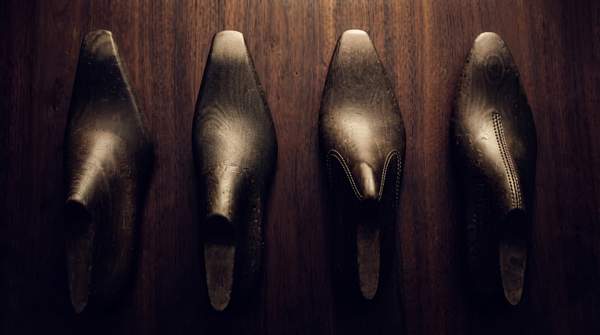
A bespoke shoe begins not with leather but with wood: a last, the mechanical form around which the entire shoe is built, carved and adjusted to the exact contours of one client's foot. Unlike the plastic lasts of factory production, a bespoke last is a unique, hand-modified object—shaped by measurement, rasps, and leather patches—whose precision determines whether the finished shoe fits or fails. Understanding how it is made reveals why custom-fit footwear commands its price and its patience.
The Foundation of Fit: What is a Shoe Last?
A last is a mechanical form used by shoemakers and cordwainers in the manufacture and repair of shoes, and it comes in many styles and sizes depending on the job: simple one-size lasts for repairing soles and heels, custom-purpose mechanized lasts for modern mass production, and custom-made lasts for bespoke footwear. As the shoemaker Amara Hark Weber, documented in a first-person account of a bespoke commission published by Gentleman's Gazette, puts it simply: a last is "the thing you build a shoe around," modeled after the human foot but "not an exact copy."
This distinction matters. The last is an interpretation of the foot, not a replica, because a shoe must hold its shape, accommodate a style, and still allow the foot to flex. In the world of bespoke footwear, the last becomes the central object of the craft: shoemakers craft lasts based on the exact measurements of the client's foot, as the K Family Shoe Factory, a shoe manufacturer, explains, ensuring that every detail is tailored to individual needs—including custom lasts for wide feet, flat feet, or high arches.
Materials for Lasts: Wood, Plastic, and Beyond
Lasts can be made from injection-molded plastic, carved wood, or cast aluminum, according to Wade Motawi of Shoemakers Academy, a shoemaking education resource, and each material suits a different scale of production. Plastic dominates ready-to-wear factory shoemaking, where identical forms are needed in bulk. Wood, by contrast, remains the material of bespoke work.
The advantages of wood are practical rather than sentimental. A wooden last can be made by copy lathe turning, CNC milling, or hand carving, and it is easy to customize with hand tools for a specific customer. Crucially, as Motawi notes, the wood surface accepts the nails and tacks required for custom-made shoe construction—a necessity when an upper is stretched and secured by hand. Aluminum and plastic serve mass production and specialized applications; wood serves the one-off, the individual, and the iterative adjustments that a single foot demands.
The Bespoke Last-Making Process: From Foot to Form
Last making is an art form, in Motawi's description: a skilled last-maker will have many years of experience and may have attended a dedicated last-making school. When a last is designed for custom shoes, every dimension of the customer's foot and the desired style must be considered—and, importantly, the majority of the relevant measurements are volume measurements rather than the length and width that ordinary shoe sizing implies.
The anatomy of the foot must be considered throughout, especially how the foot's shape changes when flexing. A static tracing of the foot would capture it at rest; a shoe must serve it in motion. The last-maker therefore works from a set of volumetric judgments—how much room the instep needs, how the heel narrows, where the ball of the foot spreads—translating them into a three-dimensional form that anticipates movement as much as it records structure.
Anatomical Considerations and Custom Modifications
Once a base or blank last is sourced, the artisan modifies it by adding or removing material to match the client's anatomy: shaving wood away with rasps, files, and sandpaper where the foot is narrower or lower, and building up with leather patches where more volume is required—for instance, a higher instep or a wider ball. Each modification answers a specific measurement taken at the outset, so that the finished form encodes the client's foot in wood.
The refinement stage is where the craft's stakes become visible. Weber, as documented in the Gentleman's Gazette account, spends considerable time perfecting the shape of the last because the more time spent perfecting it, the higher the likelihood that the shoe will truly fit. Yet even then, she acknowledges, a certain percentage of final shoes will not be satisfactory and must be remade—a candid admission of the limits of even meticulous handwork. Once the last is done, shoemaking can begin, with some makers proceeding to a trial shoe and others working directly on the final pair.
The Bespoke Last-Making Journey: A Step-by-Step Model
The craft can be understood as a sequence in which each stage has a distinct objective and a corresponding physical technique, moving from the living foot to the finished form.
| Stage | Objective | Key Action or Technique |
|---|---|---|
| Initial foot measurement | Capture the client's unique foot contours, including volume rather than mere length and width | Detailed measurements of the foot, with attention to how its shape changes when flexing |
| Last selection or creation | Establish the base form—modeled on the foot, not an exact copy of it | Choose or create a blank last, considering the desired shoe style alongside every foot dimension |
| Material choice | Match the form to the work: bespoke customization or mass production | Wood for hand-carved, one-off bespoke lasts that accept nails and tacks; plastic for factory production |
| Building up and carving | Adjust the form to the individual's anatomy | Remove wood with rasps, files, and sandpaper; add leather patches to increase volume and shape |
| Refining and finishing | Achieve a precise fit and smooth lines for the final shoe | Meticulous shaping and re-checking, since even small errors can produce a poorly fitting shoe |
Read sequentially, the model shows how a generic form becomes a personal one: measurement defines the problem, material choice sets the medium, and the alternating subtraction and addition of material solves it. The sequence also explains why the process resists shortcuts—each stage depends on the accuracy of the one before it.
Appreciating the Craft: The Impact of a Bespoke Last
Recognize that a bespoke shoe last is a critical, custom-crafted foundation, not merely a generic mold, directly influencing the comfort and fit of high-end footwear. The measurable indicator of its success is the fit and comfort of the finished bespoke shoe—particularly how it accommodates the client's unique foot contours and movements, from instep volume to flexion. When a shoe made on a hand-perfected last holds its wearer's foot without pressure or slip, that fit is the visible residue of measurements, carvings, and leather patches applied in deliberate order; when it fails, even experienced makers concede, the shoe must be remade.
Sources
- Last - Wikipedia — EN
- Shaping Bespoke Shoe Lasts By Hand & Machine — Gentleman's Gazette
- What is a Shoe Last? Shoe Lasting Guide - The K Family Shoe Factory
- How Shoe Lasts are Made — Shoemakers Academy