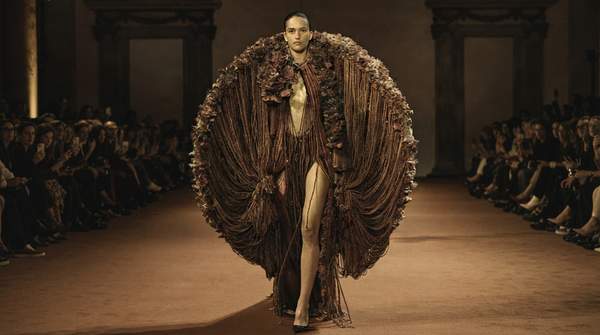
When art movements entered the couture atelier, they did not arrive as decoration alone. Art Nouveau gave couturiers a new body to dress—flowing, tubular, freed from the corset—while Surrealism, decades later, gave them a new mind to unsettle, producing conceptual garments that displaced objects and subverted reality. The first reshaped silhouette; the second reshaped meaning. Understanding that distinction is the key to reading 20th-century haute couture as a dialogue between fine art and fashion rather than a one-way borrowing of ornament.
Art Nouveau: Embracing Organic Forms and Flowing Silhouettes
Art Nouveau, flourishing in the years around the turn of the century, proposed what one costume-history account calls a "completely new visual concept of 'pure art'"—an aesthetic that crossed into Edwardian, Aesthetic, Dress Reform and haute couture trends alike, integrating quality craftsmanship with new technology and equipment. Its visual language favored broad, abstract expanses of bright color and simple line, a combination that proved unusually well suited to the simplified gowns of the era.
What did that mean for the body itself? The account links the new straight-lined, lightly ornamented gowns—worn with a brassiere rather than a corset—to the progress and emancipation of women, with the Art Nouveau style fitting this visual shift. The movement's emphasis on organic line and natural form thus translated not into applied trim but into structure: a garment that hung, draped and moved rather than one that compressed and reshaped.
Paul Poiret: A Couturier's Interpretation of Art Nouveau
Paul Poiret is the clearest conduit between Art Nouveau's principles and the couture garment. A key influence in the movement, he believed "less is more," moved in artistic circles, employed Parisian painters, and considered those in the fine arts "in the same trade & that they are my colleagues." That self-image—as a peer of painters rather than a mere dressmaker—matters: it explains why his gowns read as composed canvases rather than tailored constructions.
His translations were radical simplifications. He drew gowns with bright color and simple line to suit the new artistic medium, introduced the hobble skirt and the brassiere, and led a reformation that freed the body from constricting forms. His dresses featured a classical-style high waistline, a tubular shape and a long skirt, in plain, bold colors—what the same account credits as the creation of "bohemian chic," with untied dresses and chemises, unsewn draped fabrics and dramatic oriental-inspired colors. His own summary was wry: "I freed the bust & shackled the legs."
Charles Worth, meanwhile, ended his career in the same current: his house produced the new tubular dress with rich ornamentation, and during the Art Nouveau period he created dramatic textiles with scrolls giving the illusion of ironwork, woven "a la disposition" so each fabric piece became an intrinsic part of the design.
Surrealism: The Unconscious and the Unexpected in Design
Surrealism offered couture something entirely different: not a line but a worldview. The Victoria and Albert Museum traces the movement to both the political theories of Karl Marx and Sigmund Freud's psychoanalysis, developed in the 1890s. The term was first coined in 1917 by the poet Guillaume Apollinaire, and in 1924 André Breton used it to describe a politically radical movement that aimed to change perceptions of the world by exploring dreams, the unconscious mind and the irrational.
Where Art Nouveau's gift to fashion was form, Surrealism's was juxtaposition. Writing on the movement's fashion legacy, Hube magazine describes its dream-like imagery and unexpected juxtapositions as infusing garments with mystery and intrigue that challenge conventional norms. The mechanism is conceptual: an object removed from its expected context, a familiar thing made strange. Fashion becomes a vehicle for subversion rather than refinement.
Elsa Schiaparelli and Salvador Dalí: Collaborations in Surreal Fashion
Elsa Schiaparelli put those principles into couture through direct collaboration with Salvador Dalí. The V&A cites the Shoe hat of 1938—a pink velvet high-heel worn on the head—as a famous example of Surrealist displacement, the object removed from its expected context. It was closely followed by the Skeleton and Tear dresses, also made with Dalí in 1938, combining humour with a morbid edge.
What makes these garments couture rather than costume is their double nature. The V&A notes that although Schiaparelli's designs pushed the boundaries of fashion, they were also smart and often very wearable. The Tear dress, with its trompe l'oeil effect of torn flesh rendered in fabric, is technically accomplished couture; the Skeleton dress maps the body's structure onto the garment itself. Displacement, in skilled hands, becomes embellishment.
Art Movements in Haute Couture: A Comparative View
Setting the two movements side by side reveals the essential contrast: Art Nouveau worked from the outside in, changing how the garment met the body; Surrealism worked from the inside out, changing what the garment meant.
| Dimension | Art Nouveau | Surrealism |
|---|---|---|
| Core principles | Organic lines, natural forms and a holistic "pure art" visual concept, integrating craftsmanship with new technology | The unconscious mind, dreams and the irrational; unexpected juxtapositions and subversion of reality. Coined in 1917, drawing on psychoanalysis |
| Haute couture designer(s) | Paul Poiret and Charles Worth, who adopted elements of the movement into their collections | Elsa Schiaparelli, collaborating with Salvador Dalí in famous examples of Surrealist influence |
| Key fashion elements | Flowing silhouettes—the tubular dress and princess gown—freeing the body from restrictive corsetry; a new visual concept in fashion | Conceptual garments: the Shoe hat, Skeleton dress and Tear dress, using displacement and trompe l'oeil—designs combining humour with a morbid edge that pushed fashion's boundaries |
Read across the rows, the table shows two distinct routes from canvas to couture. Poiret's tubular dress answers the question "how should a body be shaped?"—with organic line and emancipated structure. Schiaparelli's Tear dress answers "what can a garment mean?"—with irrational imagery made wearable. One movement modernized the silhouette; the other weaponized the embellishment.
Recognizing Art's Enduring Influence on Fashion
To fully appreciate the evolution of haute couture, one must recognize the direct and profound impact of major art movements and the designers who translated their principles. Poiret treated painters as colleagues and rebuilt the dress around Art Nouveau's simple line; Schiaparelli treated Dalí as a collaborator and rebuilt the hat, the print and the embellishment around Surrealism's displaced objects. The two cases together demonstrate that art influenced fashion through identifiable individuals acting as conduits, not through vague ambient taste.
The measurable test is attribution: the reader can identify specific design elements in historical haute couture garments and correctly attribute their inspiration to either Surrealist conceptualism or Art Nouveau organicism. A tubular, high-waisted, boldly colored gown points to the latter; a velvet high-heel worn as a hat, to the former. This article's scope is deliberately bounded—it covers these two movements in 20th-century couture, not an exhaustive survey, and not contemporary fashion—but within that frame, the pattern is clear and checkable garment by garment.
Sources
- 1899-1914 Art Nouveau — Silhouettescostumes
- Surrealism and design — Victoria and Albert Museum
- Art Movements that Revolutionized Fashion - hube magazine