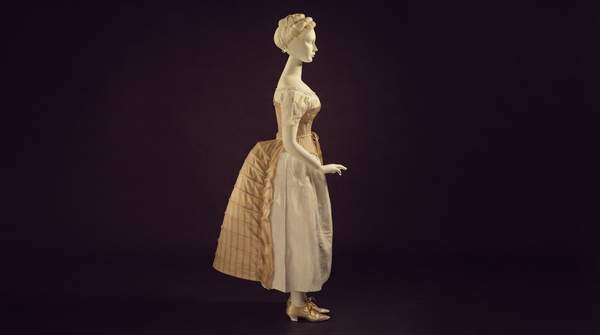
The Victorian bustle was not a single garment but a sequence of three structurally distinct understructures, each producing its own recognizable silhouette. According to the costumier behind the Historical Sewing chronology of the 1870s and 1880s, the era divides into the First Bustle Era (roughly 1868–1876), the Natural Form Era (1877–1882), and the Second Bustle Era (1883–1889), and a dress from 1871 looks, in her words, like "a distant relative" of one from 1880. Understanding those phases means looking beneath the silk: the outer shape was always a consequence of wires, hoops, pads, and woven horsehair beneath.
The Rise of the Bustle: From Crinoline to Early Form (c. 1860s-1876)
The bustle began as a redistribution of the crinoline rather than its replacement. As the Encyclopedia of World Dress and Fashion (2010) explains, the domed crinoline cage of the early 1860s first grew in circumference and then began to flatten at the front; from the late 1860s, bustle structures were used to hold skirts out at the back instead. By the early 1870s, these supports—known in French as tournures—were in general use. Their construction was strikingly varied: metal, cane, or whalebone hoops, or woven horsehair flounces, supplied the projected volume. The defining silhouette of the First Bustle Era was therefore a skirt carried outward and upward at the rear, its fullness concentrated low behind while the front of the body flattened.
The Natural Form Era: A Brief Interlude (c. 1877-1882)
Between 1877 and 1882, the wired contraption was, as the Historical Sewing account puts it, "left hanging in the closet" and replaced with a small pad resembling a woman's natural curves—hence the era's name. The silhouette changed accordingly. Overskirts drew tighter around the foundation skirt, complicated draped poufs appeared at the back, and bodices tightened and lengthened into the cuirass shape, a bodice that mimicked the long line of the corset. The Princess Dress, cut in full-length princess seams without a waistline seam, emerged from the same taste for unbroken vertical lines that emphasized height. Charles Frederick Worth, the Englishman whose House of Worth pioneered made-to-order Parisian couture, is identified as a proponent of this natural-form styling, though the surviving accounts do not detail how directly he shaped the undergarments themselves.
The Exaggerated Second Bustle: Engineering Volume (c. 1883-1889)
The bustle returned in 1883 in a far more exaggerated form and lasted until 1889, when, as the Historical Sewing chronology records, women "had had enough" of a rear that looked disproportionally huge relative to the rest of the body, and the bustle was discarded nearly overnight. The Encyclopedia of World Dress and Fashion confirms this second life, noting that bustles reappeared "in a more exaggerated form from the early 1880s," designed to puff up the back of a dress or skirt into a pronounced horizontal projection.
Construction continued to draw on the established repertoire—padded cushions and wire frames being the two methods the general encyclopedic definition of the bustle recognizes—and inventive makers kept patenting improvements: a 1902 American patent filing, published in 1903, described a "ventilated bustle and hip-form," showing that the engineering of padded rear volume persisted even after the great era had passed.
Evolution of the Victorian Bustle: A Comparative Overview
Read side by side, the three phases show how the internal support mechanism dictated the external dress. The table below contrasts each era's dates, silhouette, and characteristic construction, so that a gown from 1872, one from 1880, and one from 1885 can be distinguished at a glance.
| Era (Dates) | Silhouette Shape | Common Construction & Materials |
|---|---|---|
| First Bustle Era (c. 1868–1876), also called Early or 1870s Bustle | Skirts held out at the back, with front fullness flattened—the crinoline's volume redistributed rearward | Bustle structures and wireframe supports; hoops of metal, cane, or whalebone; woven horsehair flounces |
| Natural Form Era (c. 1877–1882) | Tighter overskirts, complicated rear drapes, long cuirass bodice; slim, elongated lines emphasizing height | A small pad, in place of the wired frame, suggesting the body's "natural" curves |
| Second Bustle Era (c. 1883–1889) | A much more exaggerated projection at the back, designed to puff up the rear of the dress | Wire frames and padded supports in more pronounced configurations; later padded forms remained patentable (ventilated bustle, 1903) |
The comparison makes the era's logic visible: the same two basic technologies—stiffened frames and soft padding—were re-proportioned twice within twenty years, first flattened into near invisibility, then inflated to their most theatrical extreme.
Haute Couture's Influence and Modern Legacy
The bustle's history is inseparable from the birth of haute couture. The Cambridge Global History of Fashion credits the "astounding success" of Charles Frederick Worth (1825–1895) with making couture's rise unstoppable, and describes the business model he established: unique seasonal designs created by the head of the house and made to order for clients by in-house ateliers. Worth's advocacy of the natural-form silhouette in the late 1870s illustrates how the founder-led couture house could set the direction of an undergarment fashion as much as an outer one, even though the records say little about his hand in the supports' construction.
The silhouette has never entirely left the couture imagination: the Fashion History Timeline at the Fashion Institute of Technology records that Rei Kawakubo of Comme des Garçons presented a contemporary twist on bustle styling in her Spring 2012 ready-to-wear collection, and that Christian Dior showed an elegant bustle-style dress in its Fall 2014 couture show. These are illustrative rather than exhaustive examples, but they demonstrate the shape's persistence as a design language for engineered volume at the back.
Understanding the Bustle's Enduring Legacy
To fully appreciate the historical context and lasting influence of Victorian fashion, one must recognize the distinct phases of the bustle era and the engineering ingenuity behind each silhouette. The practical payoff is diagnostic: the reader will be able to correctly identify the approximate era of a Victorian dress based on its bustle silhouette and describe the likely underlying construction method—a flattened front with rear hoops marks the early 1870s, a slim, draped, nearly unbroken line marks the years around 1880, and an exaggerated rear projection marks the mid-1880s.
Sources
- Bustle Era Changes – The Highs & Lows in the 1870s & 1880s – Historical Sewing — Historicalsewing
- Bustle - Wikipedia — EN
- US723495A - Ventilated bustle and hip-form. - Google Patents
- The Origins and Development of Haute Couture, 1858 to Now (Chapter 37) — Cambridge Core
- bustle — Fashionhistory