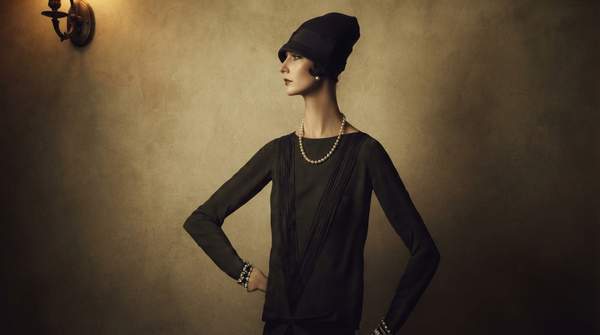
The little black dress was born in 1926, when Coco Chanel placed a simple black sheath in the pages of American Vogue, transforming black from a color of mourning into a chic, versatile choice for everyday and evening wear. Vogue's comparison of the dress to the Model T—calling it “Chanel's Ford”—captured the essence of the innovation: a garment meant to be accessible, practical, and elegant all at once, one that could be dressed up or down as occasion demanded. Nearly a century later, the same principles of simplicity, versatility, and accessibility explain why the LBD remains what one fashion college retrospective calls one of the most enduring staples in fashion history.
The Enduring Icon: What Makes the Little Black Dress Timeless?
Before tracing its revolutionary origins, it is worth asking what exactly the LBD is, because not every black dress qualifies. Fashion historians and style references describe it as a black evening or cocktail dress, cut simply and often short, and intended—by design—to be long-lasting, versatile, affordable, and widely accessible. Its ubiquity is such that it is routinely reduced to the three-letter abbreviation “LBD,” and it is considered by many fashion observers to be essential to a complete wardrobe.
Writing for the Vogue College of Fashion, Nina Ryan notes that shoppers still hunt vintage racks and flea markets for the perfect little black slip dress, a pursuit that testifies to the garment's persistence across generations of changing silhouettes. What has allowed one category of dress to survive a century of trend cycles is not a fixed design but a fixed idea: minimalism, adaptability, and an elegance that does not depend on ornament.
Before Chanel: Black as a Symbol of Mourning and Service
Chanel's invention was radical precisely because of the color she chose. Before her influence in the 1920s, black was predominantly associated with mourning attire, and it was rarely seen as a chic choice for daily or evening wear. Wikipedia's history of the garment observes that black has always been a color rich in symbolism, and in the pre-1920s wardrobe that symbolism was largely restrictive: black marked grief, and it also served as the livery of household staff and service uniforms. A woman wearing black in public, outside of bereavement, was read through that social code rather than through style. This is the convention Chanel broke.
By taking a color freighted with mourning and service and placing it at the center of fashionable dress, she detached black from its funereal meaning and reassigned it a new one—chic, modern, and available to anyone. The Glam Observer's fashion history column argues that the LBD became one of the few creations that made a single color “so perfect, unique, and symbolic” within the industry, precisely because it reversed the color's cultural meaning rather than merely using it.
Coco Chanel's 1926 Revolution: Redefining Black in Fashion
The decisive moment came in 1926, when Vogue famously featured a simple black sheath dress designed by Chanel and described it as “Chanel's Ford,” comparing it to the Model T for its accessibility and its potential to become a classic. The comparison is the key to the design's significance. The Model T was not a luxury object; it was a well-made machine produced for the many, and Chanel's dress carried the same democratic logic into couture.
It broke conventions by offering an affordable, practical, yet elegant option that could be dressed up or down, and in the 1920s it became one of the preferred dresses for creating the era's “flapper look.” One nuance matters here: the Glam Observer's account is careful to note that Chanel did not design the very first little black dress—she was the one who made it widely popular and desirable.
The revolution of 1926 was therefore less a single invention than a decisive act of legitimation, in which the most influential fashion magazine of the age endorsed a black dress as a future classic, and the social meaning of the color changed accordingly.
The LBD's Enduring Appeal: Design Principles to Cultural Impact
Understanding why the LBD became an icon—rather than merely a dated 1920s design—requires tracing how its design principles produce practical effects, which in turn generate cultural impact. The framework below maps that causal chain, and it also explains what separates a genuine LBD from an ordinary black dress: any black dress can be dark; only one that combines a simple cut and a neutral “black canvas” with genuine versatility and accessibility earns the abbreviation.
| Defining feature | Category | What it does for the wearer | Cultural consequence |
|---|---|---|---|
| Simplicity of cut | Design principle | A simple sheath, often short, is easy to wear and broadly flattering to the concept of the garment itself, requiring no ornament to read as elegant | Broad appeal beyond a single silhouette or era |
| Neutral color (black) | Design principle | Black acts as a blank “canvas” that suits various occasions and recedes so accessories carry the personality | Black redefined from mourning to chic, becoming, per the Glam Observer, a “strong, unrivaled color” in fashion |
| Versatility | Practical effect | The same dress works for daytime business with a jacket and pumps, or for evening and formal events with ornate jewelry | One garment covers many social settings, making it a rational wardrobe investment |
| Accessibility | Practical effect | As “Chanel's Ford,” the design's simplicity made chic fashion available to a broader audience beyond the elite | Democratic appeal; chic no longer reserved for the wealthy |
| Timelessness | Cultural impact | Its minimalist design remains stylish regardless of changing trends, a reliable staple season after season | Cemented status as an enduring fashion icon nearly a century on |
Read as a chain, the framework shows that the LBD's two design principles—simple cut and neutral color—do not operate separately: the plain silhouette invites accessorizing, and the black canvas makes those accessories legible, which together produce versatility. Versatility plus accessibility then produces the cultural payoff, because a garment that works everywhere and costs less than couture belongs to everyone, and a garment that belongs to everyone never goes out of fashion.
Embracing the LBD: A Wardrobe Essential for Every Era
Recognize the Little Black Dress not merely as a garment, but as a foundational fashion concept that offers enduring style and adaptability. Chanel's 1926 contribution endures because it was conceptual rather than purely sartorial: she demonstrated that a color's meaning is a social agreement that can be renegotiated by design, and that simplicity is not austerity but permission—the permission to make one dress serve many lives and occasions. The evidence of the concept's durability is measurable: the continued presence of the LBD in fashion collections, its continued rediscovery on vintage racks, and its consistent recommendation as a versatile wardrobe staple. A century after Vogue compared a black sheath to a Model T, the little black dress remains the rare fashion object whose promise—that it will still work next season, and the one after that—has never needed a redesign.
Sources
- Little Black Dress: The Evolution of a Timeless Fashion Staple — Vogue College of Fashion
- Little black dress - Wikipedia — EN
- A Little History And Evolution Of The Little Black Dress — Glamobserver