European goldwork embroidery began as a devotional art—gold and silver threads stitched onto linen for altarpieces and vestments in the medieval English workshops of Opus Anglicanum—and it survives today in two very different settings: the parade ground and the haute couture runway. What links a twelfth-century mitre to a modern couture gown is a small family of techniques, above all couching, in which metal threads are laid on the fabric's surface and secured with finer stitches rather than sewn through the cloth. Understanding those methods, and how each produces a distinct texture, is the key to identifying goldwork in any century.
The Enduring Legacy of Goldwork Embroidery
Goldwork occupies a singular place in the history of needlework because its defining material is not silk or wool but metal thread, which behaves unlike any ordinary fibre. As the School of Stitched Textiles explains in its beginner's guide to the craft, goldwork is applied to the front of the ground fabric: the metal threads are held in place with a couching stitch and their ends are taken to the back to be finished.
This single structural fact—metal laid upon cloth rather than drawn through it—shapes everything else about the craft, from the specialist tools it requires to the gleaming, sculptural surfaces it produces. The Embroiderers' Guild of America notes that Opus Anglicanum, the celebrated "English work" of the Middle Ages, depicted religious scenes in gold and silver threads, and that these pieces served royalty, nobility and the military as well as the church. That breadth of patronage, sustained across centuries, explains why goldwork never became a purely historical curiosity: it was repeatedly re-adopted by whichever institution most needed to signal wealth and authority through textiles.
From Sacred Vestments to Royal Adornment: Goldwork's Historical Trajectory
The earliest chapter of the European story is ecclesiastical. The School of Stitched Textiles traces embroidery in Britain to the Anglo-Saxon period, with the earliest known examples from around the seventh century, when it was a monastic craft: nuns and monks created elaborate vestments and altar cloths for the church. The professionalization of the craft came later, in the great medieval workshops.
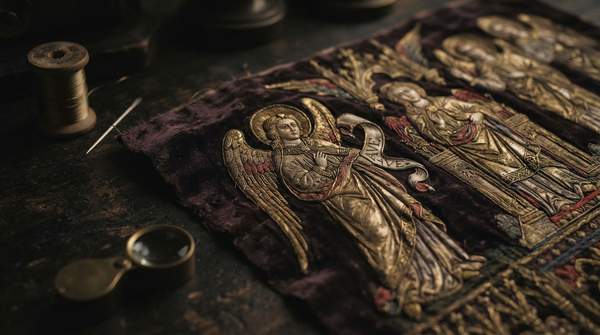
The Royal School of Needlework's stitch encyclopaedia records that underside couching—one of goldwork's most characteristic stitches—dates from the eleventh to fifteenth centuries, was worked by professional embroidery workshops, and is most famous for its use in Opus Anglicanum, where it appears as one of the most frequently used stitches. The Embroiderers' Guild of America describes Opus Anglicanum as mainly ecclesiastical in nature, with religious scenes stitched first on a linen ground and later on velvet, for use in altarpieces, vestments and mitres.
After this ecclesiastical flowering, the same materials and skills migrated to secular patrons. As the general reference on goldwork records, the technique was subsequently used frequently in the clothing and furnishings of royalty and nobility throughout Europe, and still later in military and other regalia. The Imperial and Ecclesiastical Treasury in Vienna, for instance, displays vestments decorated with accomplished or nué in the form of saints—a reminder that the sacred and the courtly shared a single technical vocabulary. This evolution reflects changing cultural and social significance over centuries: the same gleaming surface that once glorified a saint came to glorify a throne, and then a uniform.
Modern Applications: Military Regalia and Haute Couture
Goldwork's modern life is divided between ceremony and fashion. The London embroidery house Hand & Lock, which has designed and produced military insignia and ceremonial laces since 1767, observes that goldwork is now typically encountered at military parades, on costumes at government buildings, in churches, and on catwalk runways. The studio's archive of historic goldwork allows designers to draw on centuries of design for reproductions and historically accurate artworks, while its collection of modern coloured bullions supports more contemporary goldwork designs for fashion.
The haute couture connection has deep twentieth-century roots: the School of Stitched Textiles notes that designers such as Elsa Schiaparelli and Christian Dior incorporated embroidery into their haute couture collections, using it to add texture and visual interest to garments. The historical examples cited here do not exhaust the range of contemporary designers working with goldwork, but they establish the trajectory: a technique born for reliquaries now serves houses of a different kind of luxury.
Core Goldwork Techniques: Crafting Metallic Beauty
What makes goldwork technically distinctive is the relationship between thread and fabric. Because metal threads cannot be sewn through cloth in the ordinary way, nearly every goldwork method is a variation on couching: the metal thread is laid on the surface and fastened down with a second, finer thread. Hand & Lock emphasizes that with each different material, techniques must differ—an embroiderer would need to know cutwork to apply smooth purl and be skilled in couching to lay passing thread—and that these techniques are often material-specific, sometimes requiring specialist tools such as a mellor, tweezers and beeswax to lubricate the threads.
The company also cautions that some materials, techniques and tools cross over into other embroidery disciplines, which can make some forms of historic goldwork harder to identify. Padding, as the School of Stitched Textiles notes, is often used to give the work depth and dimension, creating a foundation on which the goldwork is stitched. The techniques below are the core of the European tradition.
Goldwork Techniques: Method and Visual Effect
The table below categorizes the principal European goldwork techniques by how the metal thread is applied—laid on the surface versus drawn through the fabric—and by the visual texture each method produces, from shaded pictorial surfaces to raised, patterned relief.
| Technique | Method of Application | Visual Effect | Historical Context |
|---|---|---|---|
| Couching | Metal threads are laid on the fabric's surface and secured with smaller couching stitches, then taken to the back to finish at each end; the thread never passes through the fabric in an in-and-out action. | A smooth, continuous metallic line or filling held flat against the cloth; the foundational surface for other techniques. | The basic method underlying virtually all European goldwork, including Opus Anglicanum and later royal and military work. |
| Underside Couching | The laid thread (metal or silk) is couched with a strong linen thread; the couching thread pulls the laid thread through to the reverse side of the fabric. | A textured surface on the front, with diagonal, chevron or diaper patterns created by careful placement of the couching stitches. | Dates from the 11th to 15th centuries, worked by professional workshops; one of the most frequently used stitches in Opus Anglicanum, encompassing both ecclesiastical and secular work. |
| Or Nué | A specific couching technique in which many threads of passing or Japan thread are laid down parallel and touching, and coloured silk couching stitches are worked over them, with spacing and colour varied. | A shimmering, shaded, pictorial effect—the variation in silk stitch density produces gleaming images, such as the saints on Viennese vestments. | Invented in the 15th century; displayed in the Imperial and Ecclesiastical Treasury in Vienna on vestments depicting saints. |
| Passing | A type of gold thread—consisting of a cotton core wrapped in metal—that can be couched onto the surface, and is the thread laid down in parallel rows for or nué. | A fine, even metallic surface; when couched in rows it forms the gleaming ground over which pictorial shading is worked. | A standard material of European goldwork across its ecclesiastical, royal and modern applications. |
Reading the table by its first two columns reveals the craft's central logic: every technique either leaves the metal thread resting on the surface (couching, passing) or deliberately pulls it through to the reverse (underside couching), and that single choice determines whether the finished surface reads as flat and pictorial or raised and patterned. Or nué sits at the pictorial extreme, using couching silk as a painter uses glazes, while underside couching produces the sculptural relief that made Opus Anglicanum famous. One technique named in the craft's literature, cutwork—used to apply smooth purl—cannot be detailed here, as its method and effect fall outside the sources gathered for this guide.
Appreciating Goldwork's Enduring Craftsmanship
To fully appreciate goldwork's legacy, observe how different techniques contribute to the visual richness and historical context of embroidered pieces. A vestment saint rendered in subtle gradations of gold points to or nué; a raised, chevroned surface on a medieval panel signals underside couching worked with linen thread; a smooth metallic line on a ceremonial uniform or a couture bodice is couching at its most fundamental. The measurable indicator of understanding is the recognition of specific goldwork techniques—couching, underside couching, or nué, passing—and their historical application in fashion and ceremonial items. A reader who can look at a piece, whether in a treasury, a regimental display or a runway photograph, and name both the stitch and the century that favoured it, has grasped the thread that runs from monastic linen to the modern catwalk.
Sources
- Goldwork Embroidery: A Beginner's Guide — School of Stitched Textiles
- Embroidery Techniques from Around the World: Goldwork — Embroiderers’ Guild of America
- A Complete History of Embroidery: 1000 Years of Craft Evolution — School of Stitched Textiles
- Underside couching - RSN StitchBank — Rsnstitchbank
- Goldwork (embroidery) - Wikipedia — EN
- The Tradition of Goldwork — Hand & Lock