Brocade is a shuttle-woven fabric distinguished by a supplementary weft: an extra set of threads that floats over a ground cloth to build raised, often metallic, ornamentation. Its history begins with the trading networks of the Silk Road, where sophisticated textile techniques emerged as a hallmark of advanced civilizations, and it travels, over centuries, into the workshops of Nanjing, Banaras, and Fes—each of which transformed the technique into a local art. Today the same fabric appears in bridal wear, evening gowns, and haute couture, with hand-woven Banarasi and traditional Chinese brocades still commanding premium prices as the living pinnacle of the craft.
Silk Road Origins: The Global Spread of a Woven Art
Accounts of brocade's early history consistently place its emergence within the complex trading networks of the Silk Road, where brocade served as more than a material good: it embodied a narrative of cultural expression, trade, and artistic innovation across multiple civilizations. From ancient royal courts to intricate trade routes, brocade functioned as a powerful symbol of wealth, status, and artistic achievement throughout global history.
That symbolic weight explains where the craft took root. Brocade weaving centers developed around royal courts and temples—institutions with both the resources to fund labor-intensive production and the ceremonial demand for cloth that announced rank. The pattern repeats across the traditions examined here: imperial China, the wedding economy of Banaras, and the medieval guilds of Fes all nurtured brocade because the fabric's cost and splendor suited occasions of consequence.
The technique itself is what made brocade so demanding. Unlike simpler plain or twill weaves, brocade requires yarn preparation, pattern planning, and the controlled insertion of extra weft threads so that the design sits raised upon the ground. This structural complexity—ornament built into the cloth rather than applied to its surface—is the thread connecting every regional variant, and it is why the fabric's relative cost has always reflected the hours of skilled labor embedded in each length.
Comparative Traditions of Brocade Weaving
Setting the three great brocade traditions side by side reveals how a shared weaving logic diverged under different geographies, materials, and social uses. The table below contrasts them across the dimensions that matter most to identification: what the fabric looks and feels like, what it is made from, and the cultural work it performs.
| Tradition | Key Characteristics | Common Materials | Cultural Context |
|---|---|---|---|
| Nanjing Yunjin brocade (China) | Raised, firm pattern areas with a subtle reflective quality over a smooth silk ground; relatively lightweight for a brocade but substantially structured | Pure silk ground with supplementary silk or metallic threads, giving a natural, luminous sheen | Centuries of imperial production; still made by traditional methods and recognized as UNESCO Intangible Cultural Heritage |
| Banaras brocade (India) | Designs woven directly into the fabric—floral patterns and traditional motifs integral to the structure, built through extra weft insertion and motif locking | Silk yarns, with Katan silk especially associated with Banarasi weaving; gold zari brocade documented historically | Worn by Indian women for weddings and important occasions, complemented by best jewellery; treasured as heirloom pieces; weaving likely began in the seventeenth century and developed through the eighteenth and nineteenth |
| Fassi brocade (Morocco) | Masterfully woven patterns and motifs that can represent a specific time and place or signify social status | Silk and metallic threads, creating a rich, opulent textile | Dating to medieval times with Fes at the center of the craft; special enough to adorn a bride on her wedding day—or, today, decorate an upscale hotel room |
Two contrasts deserve emphasis. Nanjing Yunjin's identity rests on material refinement and imperial continuity: a pure silk ground with supplementary silk or metallic threads produces its luminous sheen, and its heritage is preserved today through skilled craftspeople and traditional weaving methods. Banaras brocade, by contrast, is defined by structural logic—extra weft insertion and motif locking methods that directly influence durability, weight, and drape—so that its ornament cannot be separated from the cloth itself. Fassi brocade stands apart for the semiotics of its motifs, which can encode a specific time and place or signal social status.
The dating of each tradition also differs in certainty. Moroccan brocade weaving dates back to medieval times, with Fes at its center. Banaras's silk brocade weaving likely began in the seventeenth century, possibly with the migration of silk weavers from Gujarat during the famine of 1603, and developed in excellence during the eighteenth and nineteenth centuries—though the earliest surviving mention of Banaras's brocade and zari textiles comes only from the nineteenth century. These are distinct claims about distinct traditions, and the table should be read with those evidentiary boundaries in mind.
Brocade in Modern Haute Couture: A Timeless Statement
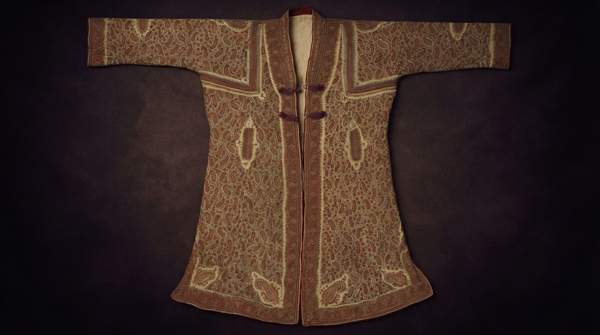
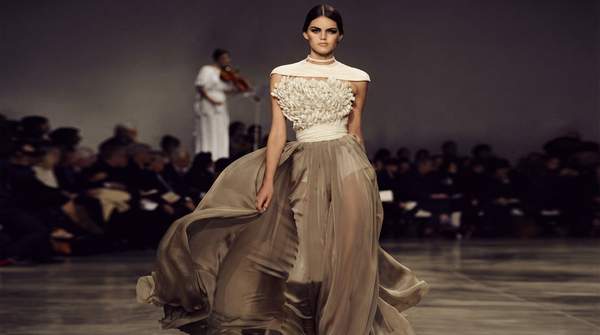
Brocade's transition from court and temple to couture house was less a rupture than a change of clientele. The fabric's structural characteristics—raised ornament, substantial body, reflective pattern areas—make it an exceptional choice across design disciplines, from haute couture fashion to interior design, and it has long served as a cornerstone of ceremonial and high-end fashion. Its documented contemporary uses include bridal wear, evening gowns, formal dress, traditional ceremonial garments, and haute couture.
What has changed is the means of production. Power-loom manufacturing has made brocade more affordable and widely available, yet this democratization has sharpened rather than erased the hierarchy within the craft: hand-woven Banarasi and traditional Chinese brocades continue to command premium prices precisely because they represent the living pinnacle of the technique. The modern market therefore contains two brocades at once—an accessible, machine-woven cloth and a hand-made one whose value lies in the hours and skill it preserves.
The Moroccan case shows how living scholarship keeps these histories legible. Morgan Snoap, a Boston University PhD candidate in African art, has spent nine months in Fes visiting workshops, master weavers, private collectors, and museum curators, tracing historic brocade weaving to the modern day for a dissertation on how this economically and culturally significant craft has evolved. Her work on how individual garments are cut, sewn, and folded demonstrates that brocade's history is still being recovered from surviving cloth—not merely recounted from archives.
Working with brocade remains demanding even for professionals. The combination of silk's slippery nature and brocade's pattern alignment requirements demands intermediate-to-advanced sewing technique, which is part of why the fabric retains its association with formal, high-stakes garments rather than everyday wear.
Recognizing Brocade's Enduring Value
To appreciate brocade as a textile with a rich, interconnected global history and diverse cultural expressions is to see one technique refracted through three societies: the imperial refinement of Nanjing Yunjin, the structurally integrated heirloom weaves of Banaras, and the status-encoding motifs of Fes. All share the fundamental supplementary weft technique, yet variations in motifs, materials, and cultural uses differentiate them—and that differentiation, not any single origin story, is what makes brocade a global rather than merely Chinese, Indian, or Moroccan achievement.
The reader can test this understanding directly: identify the distinct characteristics of brocade from different cultural centers—the luminous silk ground of Yunjin, the motif-locked wedding weaves of Banaras, the silk-and-metal status patterns of Fes—and trace the historical journey from Silk Road trade routes through royal and religious centers to modern applications in bridal wear, evening gowns, and haute couture. A garment that can be read in that way, from technique to tradition to occasion, is where brocade's enduring value becomes visible.
Sources
- What Is Brocade Fabric? Types, Uses & Styling Guide (2026) — Fabriculture Inc.
- Understanding What is Brocade Fabric and Its Uses — fabric fabric
- Client Challenge — SCRIBD
- From Wedding Attire to Living Room Curtains — Boston University
- Ualberta
- Banarasi Silk Engineering: Kadhua vs Fekwa Weaving & Heirloom Logic — Sampradaya Designer Studio
- Banarasi sari - Wikipedia — EN
- Banarasi Brocade Sarees: History, Weaving, Designs, Types & Styling Gu — Heritage Banaras Luxury