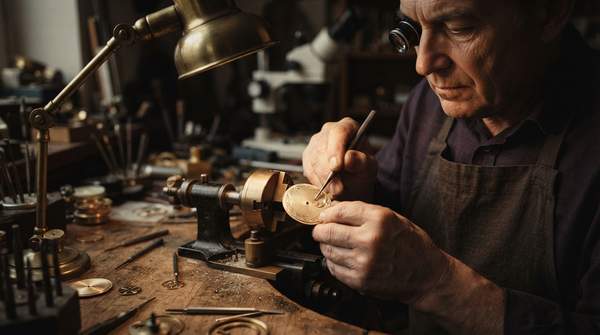
Two artisanal techniques dominate the decorative vocabulary of haute horlogerie dials: guilloché, in which a craftsperson carves repeating geometric patterns into metal, and grand feu enameling, in which powdered glass is fused to a metal base at temperatures above 800°C. Each follows a distinct, painstaking process, and each leaves a visual signature a collector can learn to recognize — engraved texture that plays with light on one hand, a smooth glassy depth on the other. Understanding how these dials are made explains both their rarity and their price.
Guilloché: Engraving Light and Shadow
Guilloché is one of the most prestigious decorative techniques in watchmaking. It involves engraving intricate geometric patterns into a metal surface using a specialized machine known as a rose engine lathe. The defining characteristic is that the work is not automatic: the craftsman manually guides the cutting tool while the dial rotates in precise patterns, so every line depends on a steady, practiced hand.
A master craftsperson uses the rose engine lathe to carve a repeating pattern into the surface of the metal dial with extreme precision. The technique creates subtle textures that interact with light, giving the dial visual depth as the viewing angle changes. Because any imperfection in the hand-cut dial is instantly noticeable, only the most skilled craftspeople perform guilloché work — and watches with guilloché dials are typically very expensive, as the Watch Collectors' Club notes in its guide to dial making.
The craft carries considerable history. Writing for Revolution Watch, Cheryl Chia traces guilloché beyond horology into decorative objects from Fabergé's Imperial Easter eggs to silverware and serving trays. Machines capable of cutting straight lines appeared by the end of the 18th century, and Abraham-Louis Breguet began applying the craft to his watches in 1786, after which the technique gained widespread popularity in the 19th century. Its appeal surged again at the turn of the 20th century, when mass production of engine-turning machines became feasible.
In practice, brands apply the technique to different materials with different consequences. Audemars Piguet uses a guilloché pattern called tapisserie, carved into brass dials that are then painted in a variety of colours, while Breguet's Classique range features guilloché dials made of gold — where, as one dial-making account observes, manufacturing mistakes can be very expensive indeed.
Enameling: Fusing Glass to Metal
Where guilloché subtracts material, enameling adds it. An enamel dial is created by applying powdered glass onto a metal base and firing it at high temperature. In its grand feu form, the process is sequential and unforgiving: a grand feu enamel dial is made by fusing powdered glass to a metal base in a kiln at extreme heat — above 800°C in the case of Rolex's off-catalog Daytona 126502, released for the Oyster's centenary — creating a glossy, luminous surface that never fades.
Ulysse Nardin, whose manufacture produces grand feu enamel dials, describes the process in explicit steps. First, the enamel powder is washed and ground with a glass or agate pestle to reduce its granulosity and obtain a homogeneous layer. Second, four to five successive layers of enamel mixed with water are applied with a brush. Third, the enamel-coated plates are placed in the oven and baked at over 800°C — and here the variables matter: the baking time and the thickness of the enamel layer influence the final colour, giving each dial a unique artisanal tone. Fourth, the enamel surface is unified with an abrasive file. Finally, before the last passage in the oven, the thickness of the dial is checked with a micrometer.
The name "grand feu" refers to the intensity of these repeated firings, and each firing adds depth and translucency to the surface. The risk is structural to the craft: each firing risks destroying the dial, which is why grand feu remains one of watchmaking's rarest and most prized techniques, as Haute Time's Seth Semilof explains. The yield problem is inseparable from the value — a dial that survives multiple passages through an 800°C kiln is a dial that has already beaten considerable odds.
For collectors in the vintage market, the material rewards scrutiny. A guide to spotting authentic enamel dials advises looking beyond appearances: examining surface texture, checking for counter-enamel, assessing how printing integrates with the surface, and understanding the model's historical context. Enamel, as that account puts it, "is not just a style — it is a material, forged in flames."
Comparative Guide to Artisanal Watch Dial Techniques
The two crafts can be distinguished along three axes: what the process does to the dial, what equipment it requires, and — most usefully for the collector — what the finished surface looks like. The table below contrasts them side by side.
| Technique | Core Process | Key Tools | Resulting Visual Hallmark |
|---|---|---|---|
| Guilloché | Intricate, repetitive geometric patterns are mechanically engraved into a metal surface; the craftsman manually guides the cutting tool while the dial rotates in precise patterns. | A rose engine lathe, along with cutting tools. | Subtle textures that interact dynamically with light, adding depth; patterns are typically geometric and can include straight lines. |
| Grand feu enameling | Finely ground glass powder is fused to a metal base through successive layers and multiple firings in a kiln at over 800°C. | A special kiln for firing, a glass or agate pestle for grinding the enamel powder, and a brush for application. | A glossy, luminous surface with exceptional depth and brilliance that resists fading; each firing adds depth and translucency. |
The contrast is easiest to see in the surface itself. A guilloché dial announces itself through relief: ridges and grooves that catch light differently as the wrist moves, structuring the dial into distinct zones. An enamel dial does the opposite — it presents an unbroken, glass-like plane whose depth comes from within the fused layers rather than from surface texture. One craft is read by touch and angle; the other by depth and glow.
Both crafts also share an economic logic. In each case, the process depends on rare skill and carries a real risk of ruin — a slip of the cutting tool on gold, a cracked enamel layer in the kiln — and that combination of manual precision and material loss is precisely what elevates these dials above industrially finished alternatives and justifies their premium.
Appreciating the Craft: What to Look For
When evaluating a luxury watch, pay close attention to the dial's surface for evidence of guilloché or enameling. The practical test is visual and immediate: the presence of intricate, repeating geometric patterns or a smooth, deeply luminous glass-like finish on the dial. A pattern that shifts with the light points to the rose engine; a flawless, glowing plane that never fades points to the kiln. Either hallmark signals hours of skilled handwork — and, given the documented risk of failure at every stage of both processes, a dial that survived its making.
Sources
- Watch Dials – How Are They Made, and Why Do They Look So Different? — Thewatchcollectorsclub
- Understanding Métiers d’Arts: Guilloché — Revolution Watch
- Watch Dial Craftsmanship: The Art and Techniques Behind Exceptional Wa — SARTORY-BILLARD
- The Art of Enamel: Grand Feu — Ulysse Nardin (United States)
- What Is Grand Feu Enamel? How Enamel Watch Dials Are Made — Haute Time
- Grand Feu Enamel Dials: Secrets of Craftsmanship and How to Spot a Fake - Lorologiese Fine Watches