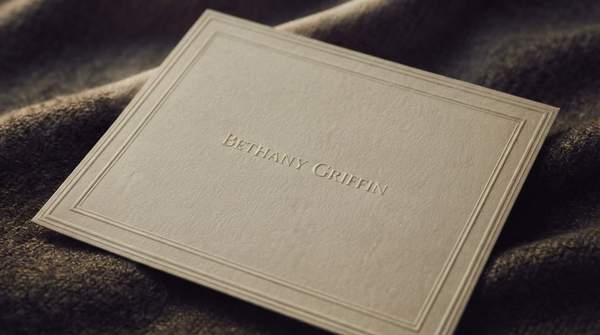
Commissioning bespoke stationery is a collaborative craft, not a catalogue purchase. It moves through a defined sequence — consultation, concept development, proofing, and production — and the most consequential choice along the way is the printing method itself. Two traditional techniques dominate luxury correspondence, and they produce opposite physical results: engraving raises the ink above the paper's surface, while letterpress presses it in. Understanding that single distinction is the key to an informed commission.
The Bespoke Journey: From Concept to Creation
The process begins with a conversation. Stationer Leah E. Moss describes her own workflow as starting with a complimentary consultation, during which she discusses the client's needs and vision, asks clarifying questions, and explains print methods, paper types, and embellishments before assembling a custom proposal tailored to the project rather than a fixed package. The design, in other words, is shaped in dialogue before a single proof exists.
From there, the work moves into concept development. Foundry Paper Co.'s Lisa Woodard describes a "blueprinting process" that includes discovering the client's story, collating mood and inspiration boards, brainstorming, sketches, and preliminary design drafts, with concepts refined before sourcing and production begin. Timing, she notes, varies with the project's scope and materials.
Practically, the commission is built from identifiable components. Woodard lists design drafts, proofing, and mock-ups; material costs; and the time and labour of production, printing, packing, and mailing, alongside up-front design fees, type design or calligraphy, layout, and base materials such as paper stocks. Specialty print methods may be outsourced. Design consultation is often included at no charge — Martha Brook's designers, for instance, offer it free with a bespoke order — and practical guidance on colour contrast and legibility forms part of that exchange.
Engraving: The Art of Raised Impressions
Engraving is a form of intaglio printing — the inverse of letterpress, as Nancy Sharon Collins, author of The Complete Engraver, puts it. In her words: "Engraved letterforms and art stand proud above the paper surface and there's a telltale bruise on the back." That bruise, an indentation visible when you turn the sheet over, is the technique's signature.
The raised result is what gives engraving its association with the most formal correspondence. Collins notes that engraving is the preferred method for presidential inaugural invitations and invitations to the Vatican, and that it pairs well with ultra-thick, 100% cotton Museum Board. For a client, the diagnostic is simple: run a finger across the front and the lettering rises; turn the sheet and the pressure that produced it is recorded on the reverse.
Letterpress: The Beauty of Debossed Texture
Letterpress works the other way around. It is a traditional relief printing method that presses raised plates onto paper to transfer ink, and it is characterized by a distinctive tactile quality and deep impression — the ink and image are pressed into the sheet rather than standing above it. The technique's lineage runs back to Gutenberg's movable metal type in 15th-century Europe, though today polymer plates commonly transfer digital artwork onto the press.
Unlike many modern printing methods, letterpress creates a physical impression that gives the finished piece its characteristic depth and texture. That tactile, artisanal feel is why it appears on high-end event invitations, premium packaging, and limited-edition posters, and why writers on the craft emphasize its "unique look and feel" alongside its versatility in fonts, colours, and finishes.
Engraving vs. Letterpress: A Comparative Guide
The two methods are mechanical opposites, and their differences can be mapped directly onto what you can see and feel. The table below contrasts them across process type and physical outcome — the practical test being whether the lettering rises toward you or sinks away.
| Printing Method | Process Type | Visual Characteristic | Tactile Feel |
|---|---|---|---|
| Engraving | Intaglio printing — the inverse of letterpress | Letterforms and art stand proud above the paper surface | Raised lettering on the front; a telltale "bruise" or indentation on the back of the sheet |
| Letterpress | Relief printing — raised plates pressed onto paper to transfer ink | Printed impression with characteristic depth and texture | Deep, debossed impression pressed into the paper |
Read the table as a decision aid, not just a description. If you want correspondence that reads as formal and ceremonial — the register of inaugural invitations — engraving's raised ink is the defining feature. If you prefer a design you can feel as a pressed, textured impression, letterpress delivers that instead. The two are not gradations of the same effect; they are opposites.
Making Your Mark: Choosing the Right Bespoke Stationery
To commission bespoke stationery that truly reflects personal style, carefully consider the desired tactile and visual qualities, understanding that engraving offers a raised effect while letterpress provides a debossed impression. Raise the question explicitly during the consultation — Moss, for one, walks clients through print methods and paper types before any proposal is written, and Woodard's blueprinting stage is where those choices are refined into a design unique to you.
The measurable checkpoint comes at proofing: the client receives and approves physical proofs that accurately represent the chosen printing method's tactile and visual characteristics. That proof is your moment of truth — run a finger across it, turn it over, and confirm the raised pride of engraving or the debossed bite of letterpress before production begins.
Sources
- The Ins-and-Outs of Custom Stationery Design — Foundry Paper Co.
- How to design custom stationery for business — Martha Brook
- Engraved Stationery, What is it? — Nancy Sharon Collins
- What is letterpress in graphic design - The Brief AI
- The Art of Ink Letterpress: Elevating Your Stationery Game - Letterpress Ink
- Thefinepress
- How the custom stationery process works - Leah E. Moss Designs