The selection of a luxury textile often hinges on its feel, its luster, and the story of its creation. In the world of silk, this choice presents a fundamental divergence between two production philosophies: conventional silk, prized for its unbroken, lustrous filament, and peace silk, defined by an ethical commitment to the life of the silkworm. This single difference in harvesting—whether the pupa is killed to preserve the cocoon’s integrity or allowed to emerge as a moth—directly dictates the final fabric's texture, appearance, and cost. This presents the consumer with a distinct set of trade-offs between animal welfare and specific material properties.
The Production Process: A Matter of Life or Death
For millennia, the vast majority of commercial silk production has relied on a method designed to yield a single, continuous thread. In this conventional process, the cocoons, most often from the Bombyx mori moth that feeds on mulberry leaves, are boiled or steamed. According to an explanation from textile company SELVANE, this critical step kills the pupa inside but preserves the cocoon’s structure. This allows a single, gossamer filament that can be up to 1,600 meters long to be carefully unwound. This unbroken thread is the source of traditional silk's celebrated smoothness and high sheen, a quality that has defined luxury for centuries.
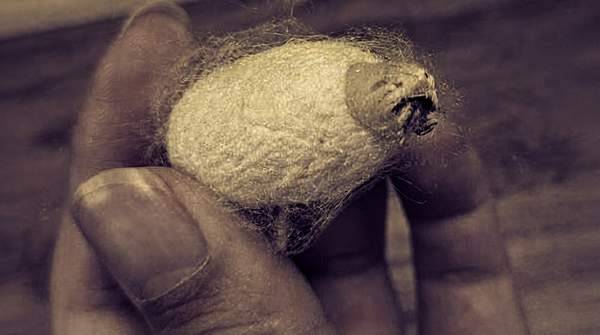
Peace silk, also known as Ahimsa silk, is defined by a radically different approach to harvesting. As explained by Theo Carter for the brand SILKSILKY, this method allows the moth to complete its metamorphosis and emerge from the cocoon naturally. Only after the moth has departed is the pierced cocoon collected for processing. While this practice avoids killing the silkworm, it fundamentally alters the raw material. The moth's exit breaks the continuous filament, changing not only the ethics of the process but also the very nature of the fiber that can be harvested and the techniques required to turn it into cloth.
From Cocoon to Cloth: How Harvesting Shapes the Fiber
The decision to preserve the silkworm's life has direct and tangible consequences for the resulting textile. Because the moth pierces the cocoon upon exiting, peace silk production yields shorter, broken pieces of fiber known as staple fibers. Unlike the long filament of conventional silk that is simply reeled from the intact cocoon, these shorter fibers must be spun together into a thread, a process more akin to creating yarn from cotton or wool. This spinning process is what gives peace silk its distinct character and texture.
This distinction between a reeled filament and a spun staple fiber is the primary source of the differences a consumer will see and feel. The long, continuous filament of conventional silk reflects light evenly along its unbroken surface, creating the material's signature luster. In contrast, the spun yarn of peace silk is composed of many overlapping shorter fibers, which scatters light and results in a fabric that is typically more matte and textured. This fundamental structural difference influences everything from the fabric's drape to how it interacts with dyes.
Conventional vs. Peace Silk: A Comparative Overview
| Attribute | Conventional Silk | Peace Silk (Ahimsa Silk) |
|---|---|---|
| Production Method | Cocoons are boiled or steamed with the pupa inside to preserve the integrity of the silk filament. | The moth is allowed to complete its life cycle and emerge, leaving behind a pierced cocoon for harvesting. |
| Silkworm Welfare | The silkworm pupa is killed during the harvesting process. | The silkworm is not killed and emerges as a moth. |
| Fiber Type | Yields a single, long, continuous filament from each intact cocoon. | Yields shorter, broken staple fibers from the pierced cocoon, which are then spun into thread. |
| Resulting Texture & Luster | Typically has a smooth, uniform, and lustrous sheen characteristic of reeled filament. | Often has a matte, slightly uneven, and textured feel due to the use of spun staple fibers. |
A Consumer's Guide to Identifying and Purchasing Peace Silk
For consumers looking to make an informed purchase, distinguishing between peace silk and conventional silk can often be done by observing the fabric's surface characteristics. While marketing language can sometimes be ambiguous, the material itself reveals its origin. According to Kanak Harari, founder of the craft-led brand JULAHAS, a close look at product photos or the fabric in person can be revealing. A "glassy, uniform sheen" is a strong indicator of conventional, reeled silk. In contrast, a "matte, slightly uneven texture" is typically characteristic of peace silk, a direct result of its spun-fiber construction.
It is also important to understand that "peace silk" describes a production method, not a specific species of silkworm, as SILKSILKY's Theo Carter points out. This means one can find peace silk made from various types of silk, including Mulberry, Eri, or Tussar. Furthermore, the production of peace silk is often a more time-consuming and artisanal process. Harari notes that it frequently involves "small-batch, often made-to-order production," which can contribute to a higher cost and a different aesthetic. The slightly porous nature of the spun fiber also affects how it takes color; block-printed designs may have a "softer, more hand-drawn look," which is considered part of its unique appeal.
Choosing Your Silk: Aligning Values with Luxury
Ultimately, the choice between conventional and peace silk is a decision that requires weighing personal priorities. There is no single "better" option, but rather a trade-off between a non-violent production ethos and a specific set of aesthetic qualities. If the primary concern is animal welfare, peace silk offers a clear advantage by allowing the silkworm to live out its natural life cycle. However, this choice comes with a different material reality: a fabric that is typically less lustrous and more textured than its conventional counterpart.
Conversely, for those who seek the classic, high-sheen, and smooth feel that has defined luxury silk for centuries, conventional silk remains the standard. Consumers should choose between conventional and peace silk by weighing their priorities regarding animal welfare, environmental impact, and desired material properties like luster and texture. The consumer's satisfaction with the silk product, reflected in its feel, appearance, and alignment with their ethical values, will indicate a successful purchasing decision.