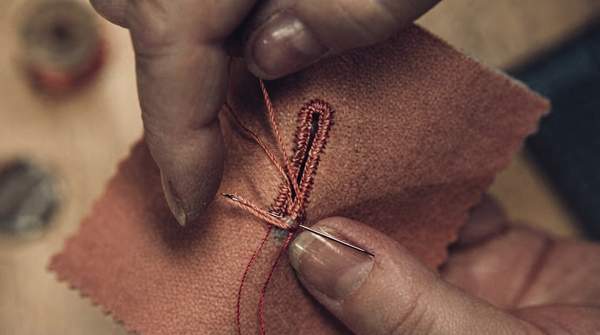
A couture buttonhole is built, not merely sewn. The traditional straight hand-sewn buttonhole—of the kind found on Savile Row coats and Parisian atelier jackets—depends on two specialized materials: silk buttonhole twist, the strong, lustrous thread that forms the visible edge, and gimp, a thin, inflexible cord that gives that edge its raised profile and prevents the opening from stretching or distorting with wear. The process itself follows a precise sequence of six stages, from basting and marking through to the final bar tack, and it is this combination of premium materials, structural reinforcement, and hours of practiced stitching that marks the finished detail as genuinely bespoke.
The Enduring Art of Hand-Sewn Buttonholes in Couture
Although many sewing machines can produce acceptable buttonholes, practitioners of the craft are unanimous that a handworked buttonhole is what distinguishes a garment as couture. Writing on her Cloning Couture blog after making hundreds of buttonholes, Mary Funt notes that the technique's appeal lies in its deceptive simplicity—there is one basic stitch, repeated over and over—while its difficulty lies in achieving stitches that are narrow, evenly spaced, and held at just the right tension, a skill that takes hours upon hours of practice. The reward is a detail that, as SELVANE's editorial team observes, speaks of heritage and a profound respect for the enduring quality of a garment, embodying a life and character that no machine can replicate. Each stitch represents a moment of focused attention, an investment in time and skill that machine work simply does not encode.
Essential Tools and Materials for Couture Buttonholes
The University of Fashion's couture techniques guide lists the refined handsewn buttonhole's toolkit as: polyester thread for basting, silk buttonhole twist, gimp, hymo (a traditional tailoring canvas), a #7 sharps needle, and an open-top thimble. Each element plays a distinct role in achieving the crisp, elevated finish that defines the technique. Silk buttonhole twist is described in that guide as the star of the process—the thread used to form the dense blanket stitches that define the buttonhole's edge. Strong, smooth, and slightly lustrous, it is the couture standard, and it can be worked in a matching shade for subtlety or a contrasting color for emphasis, carrying both the structure and the visual impact of the finished edge.
Threads Monthly's hand-sewing guide adds practical context: buttonhole twist is a thicker silk thread, very strong, with a beautiful shiny appearance, though it can be challenging to source depending on location. Where it is unavailable, that guide's author, Nisan Aktürk, reports using Gütermann's topstitching thread as a substitute of the same thickness. Funt, for her part, insists that professional materials make a difference, finding after hundreds of buttonholes that there is no substitute for Gütermann gimp.