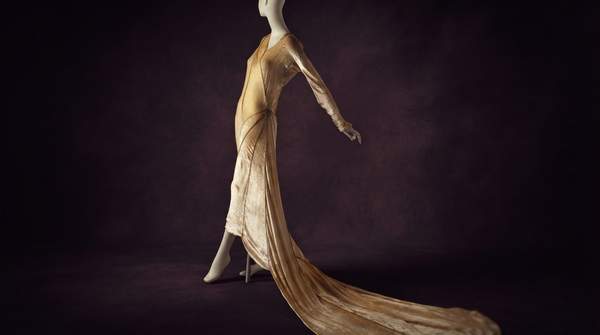
A bias-cut dress is one whose fabric has been cut at a 45-degree angle to the grain of the textile rather than along its straight threads. This seemingly simple change in geometry transforms an otherwise non-stretchy material into one with a subtle elasticity, allowing a garment to skim, cling and move with the body without darts or structured tailoring. The technique itself predates her, but it was the couturière Madeleine Vionnet who, in the early 1920s, first dared to apply it to entire garments, producing a fluid silhouette that helped free women from restrictive corsetry.
Understanding the Bias Cut: A Technical Foundation
Woven fabric is built on two sets of yarns, interlaced at right angles. A garment cut "on the straight of grain" follows those threads, inheriting their rigidity. The bias cut, by contrast, severs across the weave at a 45-degree angle. As the fashion writer Kathryn Kiernan explains, cutting this way leaves the fabric yarns at a relaxed angle instead of stretched straight across the body, which "gives an otherwise non-stretchy fabric a bit of elasticity."
That elasticity is not a marginal effect; it is the entire point of the method. Where straight-grain cloth resists the body's curves, bias-cut cloth yields to them. The result is a sinuous, slightly clingy quality that cannot be achieved by cutting along the grain, no matter how skilled the dressmaker.
The Unique Drape and Fluidity of Bias-Cut Fabric
The stretch of bias-cut fabric behaves differently from knitted or elasticized material. It is a springy, diagonal tension rather than a uniform give, and it works in both directions across the body. This dual-direction suppleness lets the cloth conform to the wearer's contours, producing what the Victoria and Albert Museum describes as "a carefully draped silhouette which clong naturally to the body" — a careful, deliberate drape that clings naturally, following the figure rather than imposing a shape upon it.
The consequences for garment construction are profound. Because the fabric itself supplies the give, a bias-cut dress can hug the body without the need for darts, the wedge-shaped tucks dressmakers historically used to force flat cloth around curved forms. Movement becomes unrestricted; the garment follows the body rather than resisting it.
Madeleine Vionnet's Revolutionary Application
In the early 1920s, the couture house of Madeleine Vionnet became known for championing the bias cut, according to the Victoria and Albert Museum's curatorial account. Vionnet had opened her own house in 1912, and though her atelier operated for only around eighteen years in total — interrupted by both world wars, with permanent retirement in 1939 — her influence on the fashion system proved durable.
Her garments flattered the curves and forms of the female body, and her chic, free-flowing dresses encouraged women to go without cumbersome corsets. What her house produced was not merely decorative novelty but a new relationship between cloth and body, made possible by the diagonal cut.
Beyond Trims: Vionnet's Full-Garment Innovation
Here lies the crucial historical distinction, and the source of a common misconception. Vionnet did not invent cutting on the bias. Fashion historians note that the technique existed before her, but that existing garments had used bias cutting only for trims and embellishments placed on fabric pieces cut along the straight of grain — a piping here, a binding there, lending a decorative flourish to otherwise conventionally constructed clothes.
Vionnet's breakthrough was to make the bias the architecture of the garment itself. She is credited with pioneering entire garments cut on the bias, a leap from ornament to structure. Her body-skimming look, in the words of one account of her career, revolutionized women's clothing and carried her to the top of the fashion world. The innovation, then, was not the existence of the technique but the audacity of its application.
Bias Cut vs. Straight Grain: A Technical Comparison
| Dimension | Straight-Grain Cutting | 45-Degree Bias Cutting |
|---|---|---|
| Cutting angle | Along the warp and weft threads of the weave | Across the grain at a 45-degree diagonal |
| Fabric property | Yarns stretched straight; little to no elasticity | Yarns at a relaxed angle; the fabric gains a springy elasticity and fluid drape |
| Garment silhouette | Structured forms; shaping requires tailoring such as darts | Soft, body-skimming; clings naturally and moves with the wearer |
| Historical application | The dominant method of garment construction; pre-Vionnet bias work appears only in trims and embellishments | Pioneered for entire garments by Madeleine Vionnet in the early 1920s |
Reading the table as a whole reveals the logic of Vionnet's achievement: by rotating the cutting angle, she transformed a stable, unyielding material into an elastic one, and by applying that rotated cut across an entire dress, she eliminated the tailoring that structured silhouettes had always demanded.
The Enduring Impact on Silhouette and Comfort
Vionnet's mastery of the bias cut shifted fashion's center of gravity from imposed structure to negotiated fluidity. Her free-flowing garments flattered the body's own curves, encouraging women to go without cumbersome corsets, and they demonstrated that a dress could both hug the figure and permit unrestricted movement. The synthesis her work implies — that liberating women from corsetry followed from designs that needed neither rigid foundations nor shaping seams — is drawn from the museum's account of garments that clung naturally while dispensing with corsets.
The bias cut survives as a living technique precisely because its logic is geometric rather than stylistic. Any era's fabric, cut across the grain at 45 degrees, acquires the same elasticity and drape; the diagonal is indifferent to fashion's cycles.
Recognizing the Legacy of the Bias Cut
To fully appreciate the historical significance of a garment, identify whether it uses the bias cut for its overall structure, particularly in fluid, body-skimming designs, since that signals a direct lineage to Madeleine Vionnet's revolutionary approach of cutting entire garments on the diagonal rather than merely trimming them with it.
The measurable indicator is visible and tactile at once: the presence of a garment's fabric stretching, clinging, and draping fluidly over the body without visible darts or seams — especially in designs from the 1920s onward — signals the application of the bias cut. A dress that moves as the body moves, holding its shape through the weave's own spring rather than through structure, is the technique's unmistakable signature.
Sources
- Madeleine Vionnet – an introduction — Victoria and Albert Museum
- Fashion Vocab: Bias-Cut — Wulfka
- MEDIUM