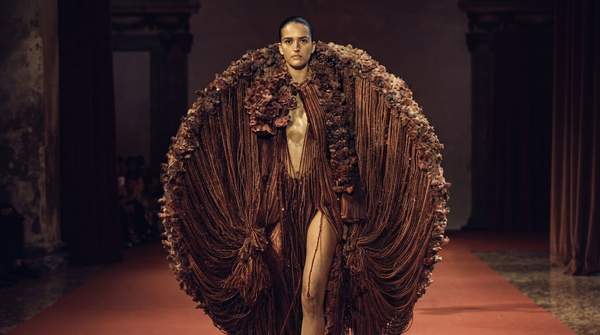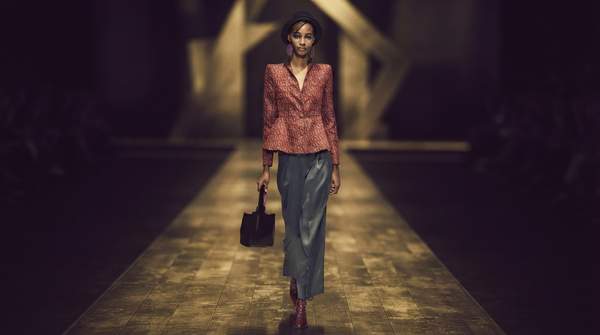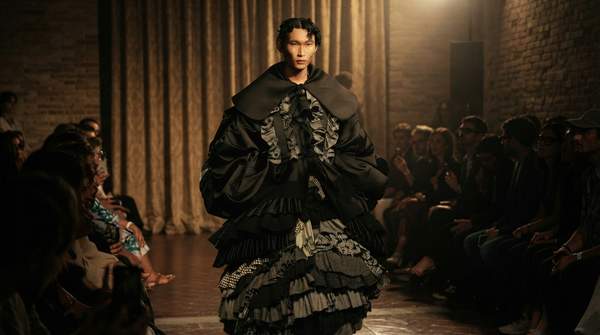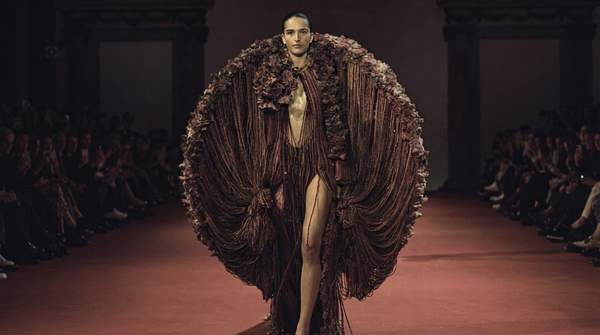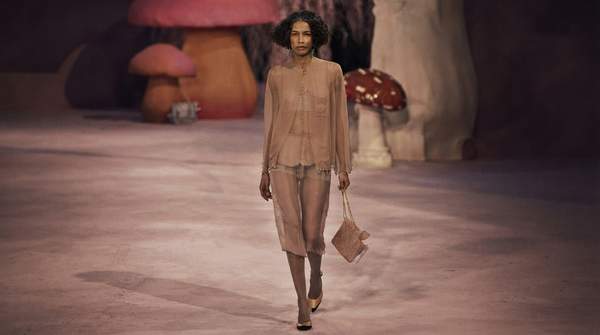
Sound in haute couture is no longer background. It is a designed narrative layer, produced by a chain of specialists — a creative director who sets the theme, a music supervisor who curates, a composer who writes original material, and a spatial sound designer who shapes how that music moves through the venue. The Chanel Haute Couture Spring-Summer 2025 show, staged on 28 January 2025 at the Grand Palais in Paris, shows the model in practice: music supervisor Michel Gaubert, composer Gustave Rudman and spatial sound designer Salvador Breed worked to transform the Grand Palais into what the spatial sound firm behind the project described as a grand, immersive spatial sound stage.
The Evolving Role of Sound in Haute Couture
The runway show has changed in kind, not merely in scale. Fashion presentations were once understood primarily as occasions for displaying clothes, with music functioning as accompaniment. Today, as the art platform TERAVARNA observes, the fashion show is positioned as an interdisciplinary "image machine" — an event that combines performance, space and narrative into a single curated experience. The Vitra Design Museum's exhibition Catwalk: The Art of the Fashion Show (2025–2026), which TERAVARNA cites, reconstructs more than a century of runway history through clothing, film, stage design and architectural models, explicitly framing shows as narrative spaces rather than mere trade displays.
Within that shift, sound has moved from the edge of the production to its center. Writing in Lampoon Magazine, Xheni Balliu describes how the soundtrack has become a tool for storytelling on the runway, with commissioned scores and live performance treated as integral to a show's meaning rather than as decoration. The practitioners themselves make the same case from the inside. In an interview feature published by HURS, four women working at the intersection of music and fashion describe their role as translating visual universes into soundscapes, infusing collections with emotional resonance, and forging immersive experiences that blur the line between runway and concert, commerce and culture.
The consequence for the audience is a different kind of event. A show scored this way asks to be experienced as a multisensory performance, in which what is heard shapes how the clothing itself is read. That is the standard against which modern haute couture sound design is now measured — not whether the music was pleasant, but whether it carried the collection's story.
Crafting the Sonic Narrative: Key Roles in Sound Design
The process begins well above the sound team. Balliu's account in Lampoon Magazine is explicit that creative directors sit at the helm of every aspect of a fashion show: their responsibilities extend beyond clothing design to curating the entire atmosphere, including music, set design, lighting and the greater storytelling of the presentation. The creative director develops the theme or narrative that will guide everything from the clothing designs to the music and setting, turning clothing into an experience that speaks to a brand's identity, cultural relevance and future vision.
Balliu illustrates the point with Alexander McQueen, whose shows were famous for dramatic storytelling — each runway presenting a unique concept, from Victorian culture to futuristic and nature-inspired themes. In her framing, creative directors are storytellers whose overarching vision provides coherence to both the show and the brand's messaging; collections carry storylines that can be political, artistic or personal. The sound team's job is to make that storyline audible.
Below the creative director, the work divides into distinct crafts. The music supervisor curates the musical elements of the show and, in ambitious cases, conceives the collaborations that make an immersive sonic environment possible. The composer writes original material, giving the collection a sonic identity that belongs to it alone rather than to a borrowed playlist. The spatial sound designer then determines how that music inhabits the venue — how it flows, envelops and moves around the seated audience. The HURS feature describes this collective work as world-building through sound: balancing brand expectations with creative freedom in a field that continues to grow in scope and significance.
The Haute Couture Sound Design Workflow
The table below deconstructs the creation of a runway soundscape into its sequence of professional contributions, showing how each role builds on the previous one to translate an abstract narrative concept into a tangible, immersive sonic event. Use it to trace how a theme becomes an experience, stage by stage.
| Stage and role | Contribution to the narrative | Chanel S/S 2025 example |
|---|---|---|
| Creative director's vision | Sets the theme or narrative that guides clothing, music, set and lighting; curates the entire atmosphere and the show's storytelling. | The Creation Studio chose colour as the collection's theme, paying tribute to Gabrielle Chanel's work as a great colourist, from blacks and whites to vivid tones. |
| Music supervision and curation | Curates the show's musical elements and envisions the collaborations that can transform a venue into an immersive spatial sound stage. | Michel Gaubert, music supervisor, envisioned the collaboration that would transform the Grand Palais into a grand, immersive spatial sound stage. |
| Original composition | Writes music specific to the collection, giving it a unique sonic identity rather than a borrowed soundtrack. | Gustave Rudman composed the show's original score, which, as DSCENE's Ana Markovic reported, amplified the experience and guided the audience through the day-to-night progression that inspired the designs. |
| Spatial sound design | Shapes how the music moves through the venue, enveloping the audience and completing the immersive environment. | Salvador Breed served as spatial sound designer; the music flowed through the venue, enveloping the audience as the models unveiled the couture creations. |
Read as a sequence, the workflow shows the reasoning path: an abstract theme (colour) is interpreted by a curator (Gaubert), given original form by a composer (Rudman), and physically realized in space by a designer (Breed). No single role produces the immersion; it emerges from each contribution building on the one before it.
Case Study: Chanel Haute Couture Spring-Summer 2025
The Chanel show of 28 January 2025 demonstrates the model under real conditions. According to the Fédération de la Haute Couture et de la Mode, the Creation Studio chose colour as the collection's central theme — a tribute to a central aspect of Gabrielle Chanel's work, honoring both her radical use of black and her mastery of every colour of the spectrum, from the softest pastels to the most vivid tones. In the centre of the Nave at the Grand Palais, the runway itself was formed by a double C sketching the infinity symbol.
The scenography and the sound were built around the same idea. Ana Markovic, reporting for DSCENE, notes that scenographer Willo Perron designed the double-C runway to evoke infinity and to nod to a chromatic circle, representing the colour progression central to the collection. The soundtrack, composed by Gustave Rudman and curated by Michel Gaubert, amplified the experience by guiding the audience through the day-to-night progression that inspired the designs.
The spatial layer completed the work. The firm responsible for the spatial sound design records that Gaubert envisioned a collaboration transforming the Grand Palais into a grand, immersive spatial sound stage, with Rudman's original composition flowing through the venue and enveloping the audience as the models, poised and graceful, unveiled the couture creations. What the evidence documents clearly is the collaboration and its immersive goal; the precise sonic techniques used to represent colour itself are not detailed in the available accounts, so the day-to-night progression reported by DSCENE remains the most specific documented link between the theme and the sound.
The example also shows why the division of labor matters. A single music supervisor with a playlist could not have produced a score that moves through a venue and tracks a chromatic narrative; that outcome required a supervisor to conceive the collaboration, a composer to write for it, and a spatial designer to realize it in the Grand Palais.
Designing Immersive Narratives: A Strategic Imperative
Modern haute couture brands must strategically integrate sophisticated sound design, involving specialized professionals, to effectively convey collection narratives and create immersive audience experiences. The Chanel case shows the pattern: a named theme, a supervisor's collaborative concept, an original score and a spatially designed environment, all serving one story. The measurable indicator to watch is the continued engagement of dedicated music supervisors, composers and spatial sound designers for future haute couture collections, and the explicit mention of sound's narrative role in show reviews — as when a review credits a soundtrack with guiding the audience through a collection's progression rather than merely accompanying it.
Sources
- 4dsound
- Fashion Runway as Curated Narrative Space in Modern Fashion — TERAVARNA
- The Soundtracks of the Runways – How Music Becomes a Tool for Storytelling — Lampoon Magazine
- The Sound of Fashion — HURS
- Symphony of Color: Chanel Spring Summer 2025 Couture Collection — DSCENE
- CHANEL Spring-Summer 2025 Haute Couture Collection — FHCM